 how-to
Delivers Precise Sizing Recommendations for Fashion Tech
Table of Contents
- Why Sizing Inconsistency Costs Retailers and Shoppers
- How AI Size Recommendation Tools for Fashion Work
- Online Clothing Size Recommendation: From Data to Fit Profile
- Body Measurement Technology for Fashion: Accuracy and Precision
- Reduce Apparel Returns with Fit Technology
- Implementing Sizing Recommendations: A Practical Guide for Retailers
- Privacy, Bias, and Responsible Use of Sizing Data
- Frequently Asked Questions
Last Updated: October 18, 2026
Why Sizing Inconsistency Costs Retailers and Shoppers
Sizing inconsistency is one of the biggest pain points in online fashion retail. A size 10 at one brand fits completely differently than a size 10 at another.
The problem runs deeper than simple measurement differences. Brands use different grading systems, fabric types, and design philosophies. A garment with stretch behaves nothing like a rigid fabric.
When you buy clothes online without trying them on, sizing becomes a guessing game. You check size charts, read reviews, hope for the best.
This is where AI-powered sizing solutions step in. They take the guesswork out of fit by analyzing body measurements and matching them to specific garments.
How AI Size Recommendation Tools for Fashion Work
AI size recommendation tools use computer vision and machine learning to solve the fit problem. The process starts with you. Upload a full-body photo. The AI analyzes your proportions and extracts key measurements. Then it compares those measurements against thousands of garment specifications in its database.
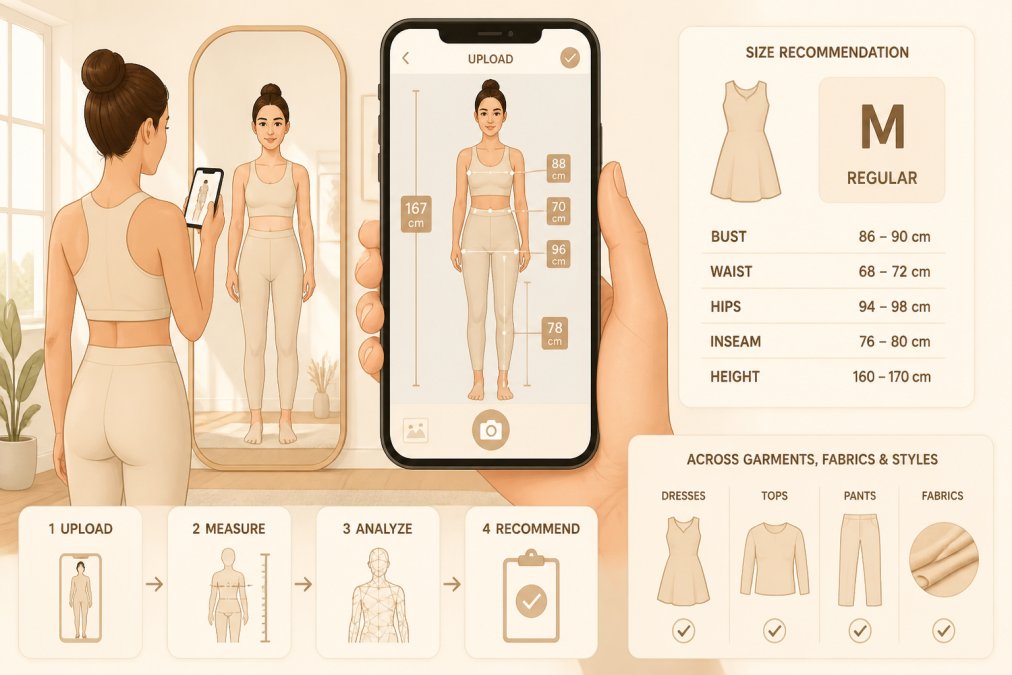
This approach works because it removes human error from fit prediction. You don't have to guess your measurements or interpret size charts. The technology does the work for you.
Capturing Body Measurements Through Photo Analysis
The first step is measurement capture. You upload a full-body photo from the front and back. Computer vision algorithms analyze your silhouette and extract key body dimensions: shoulder width, bust, waist, hip, inseam, and more.
The accuracy depends on photo quality and positioning. Good lighting matters. Standing straight matters. The AI needs clear visual information to calculate proportions correctly. Most tools guide you through the process with simple instructions.
Once measurements are captured, they're stored in your profile. You don't upload photos every time you shop. The system remembers your body data and uses it across all future recommendations.
Matching Measurements to Garment Specifications
Here's where the real intelligence happens. The AI compares your measurements against detailed product data for each garment. That product data includes dimensions for every size the brand offers.
A fitted dress needs different measurements than a relaxed-fit shirt. The algorithm understands these distinctions. It doesn't just match your bust measurement to a size. It evaluates the entire garment's fit profile and recommends the size most likely to fit your body shape and preferences.
This matching process happens in real time. Browse a product page. The tool instantly shows your recommended size based on the specific garment's specifications.
Online Clothing Size Recommendation: From Data to Fit Profile
Online clothing size recommendation systems work by building a personal fit profile for each user. This profile evolves as you shop and provide feedback. The more data the system has, the smarter it becomes.
Building a Personal Fit Profile
Your fit profile starts with your initial measurements. But it grows from there. Every time you buy something and report back on the fit, the system learns. Did the recommended size fit perfectly? The algorithm notes that.
Over time, your profile becomes a detailed map of your preferences and body characteristics. The system knows whether you prefer fitted or loose silhouettes. It knows whether you tend to run small or large in certain brands.
This personalization is what makes recommendations accurate. Generic advice says "a medium usually fits most people." Personalized recommendations account for your specific body shape, your fit preferences, and brand-specific quirks. That's the difference between a guess and a precise recommendation.
Learning Brand-Specific Sizing Quirks
Different brands size differently. Zara runs small. ASOS tends to run large. H&M's fit varies wildly by product category. A good AI system learns these patterns and adjusts recommendations accordingly.
This learning happens through aggregate data. When thousands of users shop across multiple brands and report fit outcomes, patterns emerge. The system identifies which brands consistently run small, which run large, and which are unpredictable. It builds brand profiles that inform future recommendations.
Your personal fit profile combines with brand profiles to deliver accuracy. The system knows you typically wear a medium, but it also knows that brand tends to run small, so it recommends a large for that specific item.
Body Measurement Technology for Fashion: Accuracy and Precision
The accuracy of any sizing recommendation system depends on measurement quality. If the initial body measurements are wrong, everything downstream is compromised. This is why photo analysis technology matters.
Modern computer vision can extract body measurements from photos with impressive precision. The technology identifies key anatomical landmarks and calculates distances between them.
But accuracy varies based on several factors. Photo quality matters. Lighting matters. Clothing worn during measurement affects results. A tight shirt gives different measurements than loose clothing.
The garment data side is equally important. Brands need to provide accurate product measurements. Inconsistent or incomplete product data undermines even the best measurement technology.
Reduce Apparel Returns with Fit Technology
Fit-related returns are expensive. They disrupt inventory, require restocking, and erode margins. Implementing sizing recommendation technology directly reduces these returns by improving fit accuracy before purchase.
Measuring Recommendation Accuracy
How do you know if a sizing recommendation system actually works? You measure it. The key metric is fit satisfaction: the percentage of customers who report that recommended sizes fit well.
Track this through post-purchase surveys. Ask customers whether the recommended size fit as expected. Compare fit satisfaction rates before and after implementing the recommendation system. Most retailers see 15-25% improvements in fit satisfaction when they deploy accurate sizing technology.
Another metric is return rate. Monitor returns specifically for fit-related reasons. When sizing recommendations improve, these returns decline. You can calculate the financial impact directly: fewer returns mean lower shipping costs, less inventory damage, and faster inventory turnover.
Data Quality and Continuous Improvement
Recommendation systems improve with better data. Invest in product data quality. Ensure every item has accurate measurements, fabric information, and fit notes. The more detailed your product data, the better the recommendations.
Similarly, gather feedback from customers. Ask whether recommendations were accurate. Use that feedback to refine the system. When customers report that a recommendation was wrong, investigate why. Was the product data incorrect? Was the body measurement inaccurate? Was the algorithm missing something about fit?
Continuous improvement requires this feedback loop. The system learns from mistakes and gets smarter over time.
Implementing Sizing Recommendations: A Practical Guide for Retailers
If you're a retailer considering sizing recommendation technology, here's how to implement it successfully.
Step 1: Audit Your Current Sizing Data
Start by evaluating what product data you currently have. Do all items include accurate measurements? Are fabric types documented? Is fit information available?
Most retailers find gaps. Missing measurements. Inconsistent data formats. Outdated information from old product lines. Clean this up first. Accurate product data is the foundation for accurate recommendations.
Create a data audit checklist:
- All products have measurements for each size
- Fabric content and stretch properties are documented
- Fit notes distinguish fitted, regular, and loose silhouettes
- Measurements are in consistent units (metric or imperial)
- Data is updated when designs change
Step 2: Integrate Measurement Technology with Your Product Database
Choose a sizing recommendation platform. Evaluate options based on measurement accuracy, brand integration capabilities, and ease of implementation. At Fit Perfect AI, we've built our system specifically to deliver precise sizing recommendations for fashion tech.
Connect your product database to the recommendation system. This usually involves an API integration or data feed. The platform needs access to all your product measurements and specifications. Ensure the data pipeline is clean and continuous. As you add new products, their specifications should automatically flow into the recommendation engine.
Test the integration thoroughly. Run sample recommendations through the system. Verify that the technology correctly accesses your product data and generates recommendations.
Step 3: Test Recommendations Against Real Purchase History
Before launching to all customers, validate the system against your historical data. Look at past purchases. Generate recommendations for those items using the technology. Compare the recommended size against the size the customer actually purchased.
If the system recommends the same size customers actually bought, that's a good sign. If recommendations differ significantly, investigate. Are the product measurements wrong? Is the measurement technology underperforming? Is the matching algorithm missing something?
Run this validation across different product categories. Sizing behavior differs between tops, bottoms, dresses, and outerwear. Ensure the system performs well across all categories.
Step 4: Monitor Fit-Related Return Rates
Launch the recommendation system to a subset of customers first. Monitor fit-related returns closely. Compare return rates between customers using recommendations and those who don't.
Track these metrics:
- Return rate for customers with recommendations
- Return rate for customers without recommendations
- Customer satisfaction scores for fit
- Time from purchase to return
- Reasons cited for returns
If your results differ significantly, analyze why. Are product measurements still inaccurate? Is customer feedback suggesting the recommendations are off? Use this data to refine the system.
Privacy, Bias, and Responsible Use of Sizing Data
Sizing recommendation systems collect body measurement data.
Privacy matters. Customers upload full-body photos to get measurements extracted. Where does that data go?
Responsible systems delete photos after measurement extraction. The photos themselves aren't stored. Only the extracted measurements remain.
Bias is another consideration. AI systems trained on limited body types can perform poorly for underrepresented populations.
Fit Perfect AI is committed to delivering accurate recommendations for all customers, regardless of body shape or size.
The technology should help shoppers, not exclude them.
Sizing inconsistency has frustrated online shoppers for years. But the technology to solve it exists now.
At Fit Perfect AI, we help retailers and shoppers solve the fit problem.
Frequently Asked Questions
How accurate are online clothing size recommendations compared to traditional size charts?
Online clothing size recommendation systems that analyze body measurements and garment data achieve higher accuracy than static size charts because they account for individual body shape, fabric stretch, and brand-specific fit variations. Accuracy improves over time as the system learns your fit preferences and purchase history. However, accuracy depends on data quality, precise measurements, complete garment specifications, and real feedback from prior purchases all contribute to better predictions. Systems that incorporate customer return data and fit feedback refine their recommendations continuously.
Can AI sizing technology account for differences between brands like Zara, H&M, and ASOS?
Yes, advanced AI size recommendation tools for fashion learn brand-specific sizing quirks by analyzing purchase history, returns, and fit feedback across different retailers. The system builds a model of how each brand's size grading differs, whether a brand runs large, small, or has inconsistent sizing across product categories. Over time, the technology recognizes that your true size in Zara may differ from your size in H&M, and it adjusts recommendations accordingly. This requires sufficient data from your shopping history and feedback to calibrate accurately.
What body measurement technology for fashion do I need to provide to get a sizing recommendation?
Most body measurement technology for fashion uses full-body photos to extract key dimensions: chest, waist, hip, inseam, and shoulder width. You typically upload a front-facing photo in fitted clothing or undergarments. The system analyzes proportions and body shape to generate measurements without requiring manual input. Some systems also factor in fit preferences you've indicated in prior purchases. The more data the system collects about your body and your fit preferences, the more precise your recommendations become.
How do retailers measure whether sizing recommendations actually reduce returns?
Retailers track fit-related return rates before and after implementing sizing recommendation technology. They compare the percentage of returns attributed to poor fit or incorrect size across cohorts, shoppers using recommendations versus those using traditional size charts. Additional metrics include conversion rate (whether recommendation confidence increases purchase completion), customer satisfaction scores, and repeat purchase behavior. A/B testing on specific product categories helps isolate the impact of sizing technology. Accurate measurement requires isolating fit-related returns from other return reasons (quality, style preference, damage).