 how-to
How Accurate Is AI Clothing Sizing: 2026 Guide
Table of Contents
- What AI Clothing Sizing Actually Measures
- Photo-Based Body Measurement: How Accurate It Really Is
- AI Body Measurement Accuracy vs Size Charts
- 3D Body Scanning for Clothing: A More Precise Alternative
- Understanding AI Body Measurement Accuracy: Sources of Error
- How to Verify AI Sizing Recommendations for Your Body
- Does AI Sizing Reduce Returns?
- Frequently Asked Questions
Last Updated: October 16, 2026
What AI Clothing Sizing Actually Measures
AI clothing sizing works by analyzing your body's dimensions and matching them to garment specifications. But the process is more nuanced than just measuring your chest and waist. Here's what the technology actually does when you upload a photo.
How accurate is AI clothing sizing depends on understanding what the system measures and how it uses those measurements. The AI detects specific body landmarks: shoulder width, arm length, torso height, and how your body fills space.
Body dimensions the AI detects
The AI identifies key points on your body using computer vision. These include shoulder width, chest circumference, waist position, hip width, and inseam length. The system also notes your posture and how clothing naturally drapes on your frame.
The technology captures more than just static measurements. It observes how your body relates to clothing fit.
What the AI does with those measurements
Once measurements are captured, the AI compares them against a brand's size chart and historical fit data. If thousands of customers with similar measurements rated a size as too loose or too tight, the system learns that pattern.
The recommendation isn't just "wear a medium." It's "wear a medium in this brand's fitted style, but go up to a large in their relaxed fit." This specificity is what separates AI sizing from generic size charts.
Photo-Based Body Measurement: How Accurate It Really Is
Photo-based measurement has real limitations. The accuracy depends on how you pose, your clothing, lighting, and the AI's training data. Most systems achieve reasonable accuracy for standard body types but struggle with less common proportions.
How accurate is AI clothing sizing when using just a single photo? The measurement error typically ranges from acceptable to problematic depending on the body region being measured. Shoulder width and torso length are usually captured well.
Measurement error by body region
Shoulder width detection is generally reliable. The AI can identify shoulder landmarks even through clothing. Chest and torso measurements are also reasonably accurate because the silhouette is clear.
Waist and hip measurements introduce more error. If you're wearing loose clothing, the AI can't see your actual waist position. If your posture shifts between photos, measurements change.
Arm length and inseam are among the trickiest. These require you to stand in a specific position and wear clothing that reveals your limbs.
Factors that reduce accuracy in your photos
Clothing fit matters enormously. Baggy shirts hide your shoulder width. Loose pants obscure hip and thigh dimensions.
Posture changes everything. If you stand straight in one photo and relaxed in another, measurements shift.
Lighting affects edge detection. Harsh shadows create unclear body outlines. Soft, even lighting helps the AI identify your boundaries more precisely.
Background clutter can confuse the system. A busy background behind you makes it harder for the AI to isolate your body's edges.
AI Body Measurement Accuracy vs Size Charts
AI sizing and traditional size charts solve different problems. Size charts are static. They assume all mediums fit the same way. AI sizing adapts to individual variation.
How accurate is AI clothing sizing compared to a brand's published size chart? In most cases, AI recommendations outperform generic charts because they account for body diversity. But size charts still win in specific scenarios.
Why AI often beats static size charts
AI learns from actual customer fit feedback. When thousands of people with similar measurements rate a garment's fit, that data shapes future recommendations. Size charts can't adapt. They're published once and rarely updated.
AI catches brand-specific quirks. One brand's medium might run small. Another's runs large. The AI learns these patterns. A size chart can't account for inconsistency across brands.
AI handles body diversity better. Not everyone fits the standard proportions a size chart assumes.
When size charts still win
Size charts work well when you already know your measurements. If you've measured yourself and know your exact chest size, a clear size chart gives you confidence.
Size charts are faster. No photo upload, no processing time. You check the chart and order.
Size charts don't require data sharing. Some shoppers prefer not uploading photos to an app. A printed size chart requires no personal data.
3D Body Scanning for Clothing: A More Precise Alternative
3D body scanning represents the most accurate method for capturing body dimensions. Instead of analyzing a 2D photo, the system creates a complete three-dimensional model of your body. This eliminates many of the variables that reduce photo-based accuracy.
The technology uses depth sensors or multiple camera angles to build a detailed 3D map. It captures body curvature, volume, and exact proportions from all angles simultaneously. There's no guessing about hidden dimensions.
How 3D scanning differs from photo analysis
Photo-based AI analyzes a 2D image. It infers 3D information from shadows, proportions, and learned patterns. This works reasonably well but involves estimation.
3D scanning captures actual three-dimensional data. It measures volume, depth, and curvature directly. There's less room for interpretation because the system sees the full shape.
Photo analysis depends on lighting, posture, and clothing. 3D scanning is more forgiving. The system captures your body from multiple angles, so small postural shifts matter less.
Accuracy gains and practical trade-offs
3D scanning typically delivers measurement accuracy within 1-2 centimeters across all body regions. Photo-based systems usually achieve 2-5 centimeter accuracy, with larger errors in certain areas.
But 3D scanning requires specialized equipment. You need access to a 3D scanner, which most people don't have at home.
The process takes longer. Capturing a 3D body scan requires standing still for 30-60 seconds while sensors collect data. Photo-based sizing takes seconds.
Understanding AI Body Measurement Accuracy: Sources of Error
Measurement accuracy and fit accuracy are not the same thing. You can measure someone perfectly and still recommend the wrong size if the AI doesn't understand how measurements translate to fit.
Several factors introduce error into AI sizing systems. Understanding these helps you assess whether recommendations will work for your body.
Clothing fit versus measurement precision
Measurement precision means the AI accurately captures your dimensions. Fit accuracy means the recommended size actually feels right when you wear it.
These diverge when the AI measures you correctly but misunderstands how those measurements relate to garment fit.
The AI learns fit relationships from historical data. If the training data is biased toward certain body types, recommendations for other body types suffer.
Bias in training data and body diversity
Most AI sizing systems trained on data from large populations. But "large" doesn't mean representative. If training data skews toward one body type, the AI performs worse for others.
Someone with a very curvy figure, a tall and lean frame, or an athletic build might find recommendations less accurate if those body types are underrepresented in the training data.
The best AI sizing systems acknowledge this limitation. They perform better for some body shapes than others.
How to Verify AI Sizing Recommendations for Your Body
Before you rely on AI sizing for expensive purchases, test the system with your actual body. This requires uploading a photo, getting a recommendation, making a purchase, and evaluating the fit.
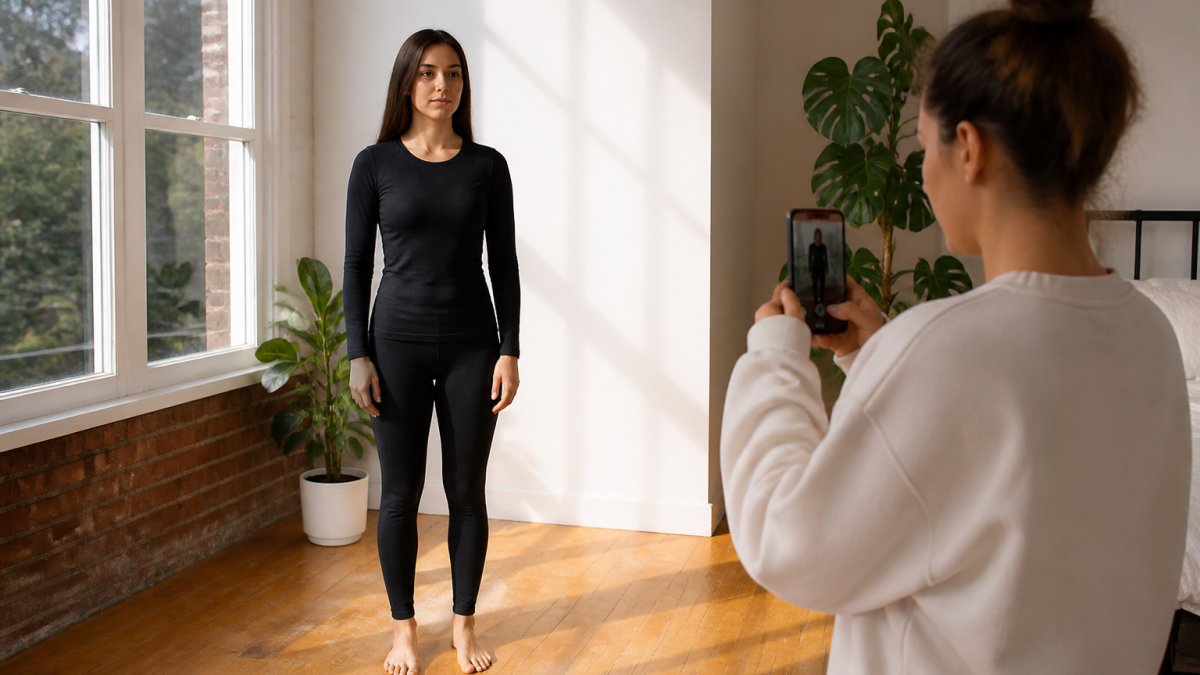
What to wear and how to pose for best results
Wear fitted but not tight clothing. A fitted t-shirt and fitted jeans work well. Avoid baggy clothing that hides your proportions.
Stand straight and face the camera directly. Keep your arms at your sides or slightly away from your body.
Use natural lighting if possible. Stand near a window or outdoors. If you use indoor lighting, avoid harsh shadows.
Use a plain background. A solid wall or neutral room background helps the AI focus on your body.
Testing recommendations on your first purchase
Order from a brand you haven't worn before. Choose an item in the AI-recommended size. Pay attention to how it fits.
Does the garment feel too loose or too tight in the chest? How about the waist? Does the sleeve length work? Does the torso length feel right?
Document the fit. If the recommendation was accurate, you've validated the system for your body. If it was off, note which dimensions were wrong. This helps you adjust future recommendations.
Cross-checking against brand-specific quirks
Some brands run small. Others run large. Some are inconsistent across styles. After testing, you'll learn how each brand compares to the AI's recommendation.
If a brand consistently runs small, you might size up even when the AI recommends a standard size.
The AI learns these patterns over time. As more customers provide feedback, recommendations improve. But in the early stages, you might need to adjust based on brand knowledge.
Does AI Sizing Reduce Returns?
The core promise of AI sizing is reducing returns.
Research on return rates shows that sizing issues account for a significant portion of online apparel returns. Anything that improves sizing accuracy should theoretically reduce returns.
But accuracy alone doesn't guarantee lower returns. Fit is subjective.
The most honest assessment: AI sizing reduces returns for customers who have consistent fit preferences and typical proportions.
Test recommendations on one affordable item before relying on them for expensive purchases.
Ready to find your perfect fit? Register with Fit Perfect AI and upload your first photo.
Frequently Asked Questions
How accurate is AI clothing sizing compared to traditional size charts?
AI clothing sizing accuracy depends on the method. Photo-based measurement typically predicts chest, waist, and hip dimensions within 1-3 centimetres of actual measurements, which is comparable to or better than static size charts. However, accuracy varies by body region, shoulders and inseam are harder to predict from photos alone. The real advantage is that AI can cross-reference your measurements against specific brand sizing quirks, whereas a size chart gives generic guidance. Fit accuracy (whether the garment actually fits well) is separate from measurement accuracy and depends on fabric, style, and personal preference.
What factors affect the accuracy of AI body measurement?
Key factors include clothing fit during the photo (tight clothes show shape better than loose ones), lighting quality, posture consistency, camera distance, and body diversity in the AI's training data. Certain body regions, shoulders, hip width, and sleeve length, are harder to measure from a single photo than chest or waist. Pose variation between photos can introduce error. Brands that use inconsistent sizing standards also make it harder for AI to predict fit across their range, even if body measurements are accurate.
Can AI body scanning measure you accurately at home?
Photo-based AI measurement works reasonably well at home if you follow setup guidelines: wear fitted clothing, use good lighting, stand at the correct distance, and maintain neutral posture. Most systems achieve measurement accuracy within 2-5 centimetres for major dimensions. 3D body scanning (using depth sensors or multiple photos) is more accurate than single-photo analysis but requires compatible hardware. For the most reliable results, take multiple photos from different angles and let the system average the data. Home measurement is less precise than professional fitting but far more convenient and adequate for most online shoppers.
Does AI sizing work for different body types and sizes?
AI sizing works across a wide range of body types, but accuracy depends on how well the training data represents your body shape. Systems trained primarily on standard sizes may struggle with plus-size, petite, or athletic body types. Curvier figures and those between standard sizes can still receive useful recommendations, but the confidence level may be lower. The best approach is to test the system on a low-stakes purchase first and provide feedback so the AI learns your specific fit preferences.