 how-to
How to Measure Body Accurately at Home
Quick Summary
To measure body accurately at home, use a flexible measuring tape on bare skin or fitted underwear, stand tall with relaxed posture, and take each measurement twice. Measure in the morning at the same time each session, and average the two readings.
- Use a flexible tape marked in centimetres and inches, and replace it if it stretches or is damaged.
- Measure on bare skin or fitted underwear so clothing layers do not add extra inches.
- Keep the tape level and snug, with one finger able to slide underneath.
- Take each measurement twice; if they differ by more than about a centimetre, measure a third time.
- Measure at the same time of day, ideally in the morning before eating, and record each reading immediately.
Table of Contents
- What You Need Before You Measure Your Body
- How to Stand and Position Yourself for Accurate Measurements
- How to Measure Your Chest, Waist and Hips with a Measuring Tape
- How to Take Body Measurements for Clothing
- How to Take Body Measurements for Fitness Tracking
- Common Measuring Mistakes and How to Correct Them
- How AI Body Scanning for Clothing Measurements Compares
- Using Your Measurements to Shop with Fit Perfect AI
- Frequently Asked Questions
What You Need Before You Measure Your Body
Most people measure their body once, write the numbers down, and never think about it again, which is why learning to measure body accurately matters so much. That is why so many clothing orders come back wrong. A few minutes of preparation makes your numbers far more reliable, and the right tools matter more than most shoppers expect.
Before you start, gather a flexible measuring tape, a notepad or phone, and a helper if you can get one. Take your measurements on bare skin or in fitted underwear, so that clothing layers don't add extra inches.
Choosing a flexible measuring tape
A flexible measuring tape is made of soft fabric or vinyl and marked in both centimetres and inches. Our guide on how accurate AI clothing sizing is explains how reliably these numbers can be used to recommend a size. It bends around curves, which makes it the right tool for body measurements. A rigid ruler or a metal construction tape will not wrap around your chest or hips.
Look for a tape that is clearly marked, lies flat, and does not stretch. Cheap tapes often stretch over time, and a stretched tape gives numbers that are too small. Keep the same tape for every measurement so your results stay consistent.
Watch out: Do not use a tape that has been bent, creased or left in a hot car. A damaged tape can shift your reading by a centimetre or more.
Preparing your body and your timing
Your body changes during the day. Bloating after a meal, a full bladder, or a long day of sitting can all make your waist look bigger. For the most reliable numbers, measure in the morning, before you eat, and at the same time each time you repeat the process.
Keeping the same conditions for repeated measurements, including time of day, body position and room temperature, makes your readings more comparable. Take your measurements twice and average the results. If the two readings differ by more than a centimetre, measure a third time.
How to Stand and Position Yourself for Accurate Measurements
Your posture changes the numbers more than most people realise. Stand tall with your feet about hip-width apart and your weight evenly spread. Relax your shoulders and let your arms hang loosely at your sides. Do not suck in your stomach or puff out your chest.
Look straight ahead, not down at the tape. Keep your back straight, but do not arch it. If you have someone helping, ask them to stand beside you and check that the tape stays level all the way around.
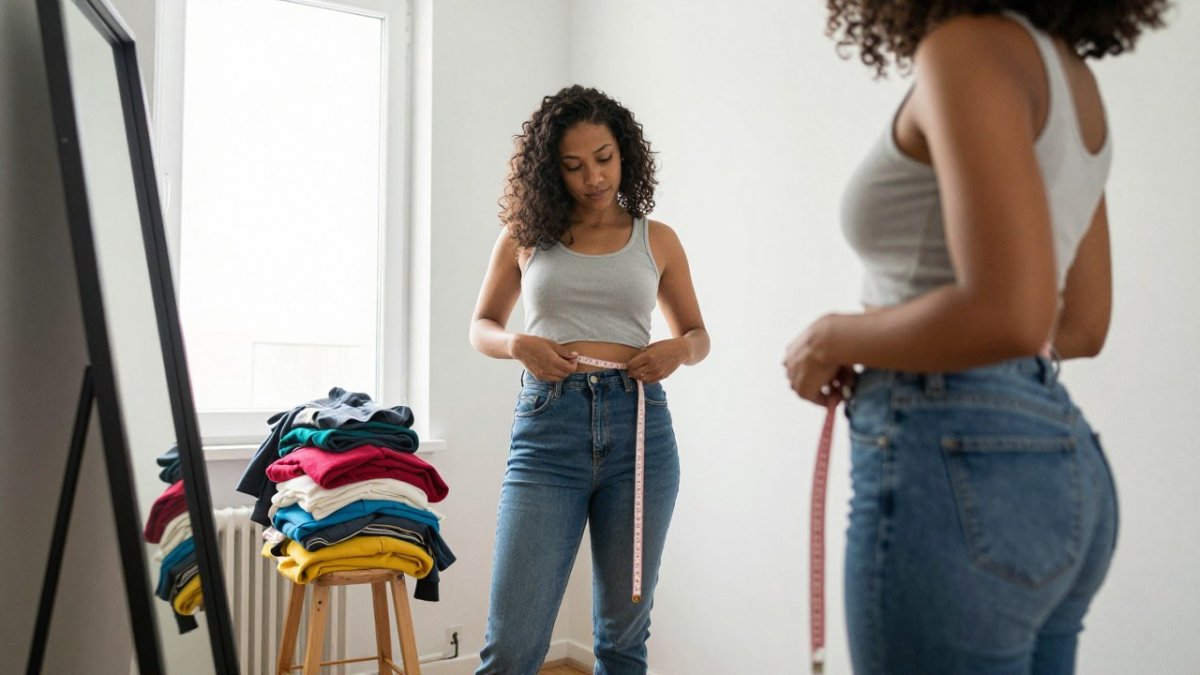
Stand in front of a mirror so you can see whether the tape sits flat. A tape that slants up or down will give you a number that is too large.
How to Measure Your Chest, Waist and Hips with a Measuring Tape
These three measurements are the core of most clothing size charts, so learn to measure body accurately at these points first. The difference between a good and a bad reading usually comes down to finding the right landmark and keeping the tape level, not to how hard you pull.
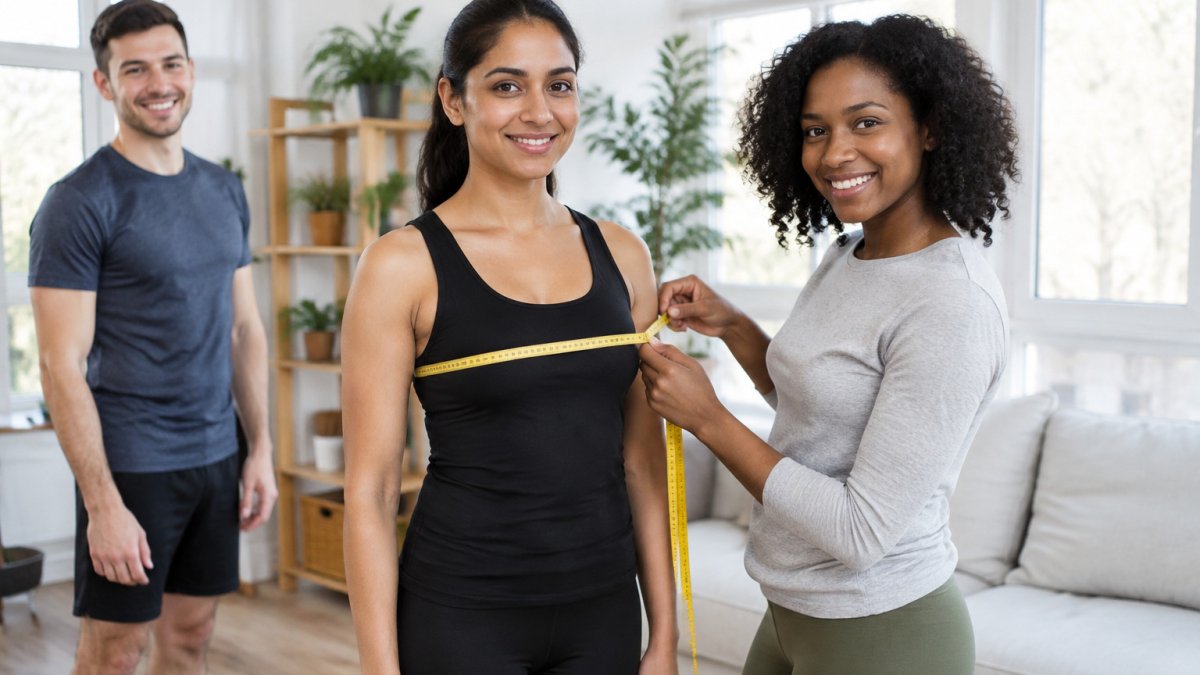
Chest or bust: Wrap the tape around the fullest part of your chest, keeping it level under your arms and across the shoulder blades. Keeping the tape level and relaxed helps avoid common measurement mistakes that can throw off a fit.
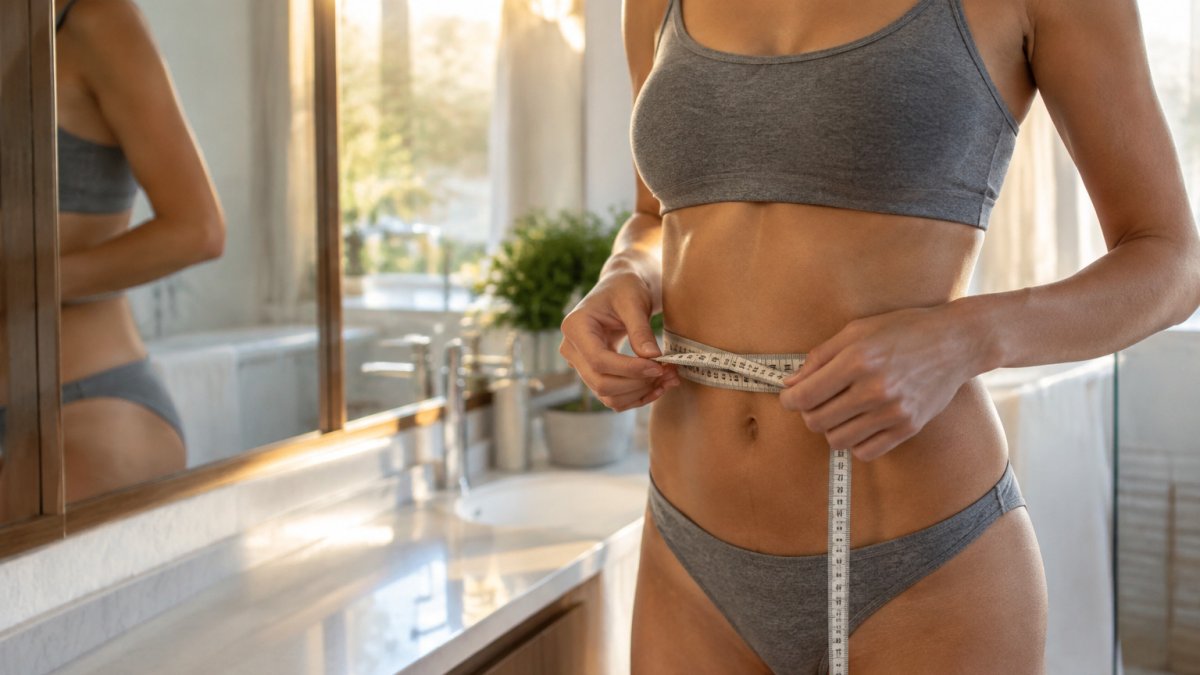
Waist: Find the narrowest part of your torso, usually a little above your belly button and below the bottom of your ribcage. If you cannot see a clear narrowing, bend sideways slightly; the crease that forms is a reliable waist landmark.
Hips: Stand with your feet together and wrap the tape around the fullest part of your hips and seat, usually about 20 cm below your waist.
Keep the tape snug against your skin without pulling it tight. You should be able to slide one finger under it.
If your body shape makes a landmark hard to find, measure at the same fixed point every time and record a note next to the number.
How to Take Body Measurements for Clothing
Clothing sizes differ from brand to brand, so your body measurements are more useful than a size label. For tops, you need your chest, waist and shoulder width. For trousers and skirts, you need your waist, hips and inseam.
Measure your inseam by standing straight and measuring from the crotch down to the ankle bone. Compare your numbers with the brand's size chart, not with the size you usually wear.
Take the same measurements every time you shop. A stored set of numbers helps you compare brands faster and cut down on returns.
How to Take Body Measurements for Fitness Tracking
If you are tracking fitness progress, measure the same spots every few weeks. Common points include the chest, waist, hips, upper arm, thigh and calf. Use the same tape and the same posture each time.
Write your numbers in a simple log, with the date next to each set. Changes of a centimetre or two over several weeks are normal and tell you more than a single reading ever will.
Common Measuring Mistakes and How to Correct Them
Most errors come from the same few habits, and each one has a specific fix. The table below pairs the mistake with what it does to your number and how to correct it.
- Measuring over clothes. Thick fabric adds inches, and a waistband can add a centimetre or more. Correct it by measuring on bare skin or in fitted underwear, and note which you used so future readings match.
- Tilted tape. A tape that slants up at the back or dips at the front gives a number that is too large. Correct it by standing in front of a mirror and checking that the tape is horizontal at the front, sides, and back before you read the number.
- Pulling the tape too tight. A tight tape compresses soft tissue and gives a small number. Correct it by keeping the tape snug enough to stay in place but loose enough to slide one finger underneath.
- Holding your breath. A held breath changes chest and waist readings. Correct it by breathing normally and reading the tape at the end of a normal exhale, not at a forced exhale.
- Flexing muscles. Flexed arms and legs read larger than relaxed ones. Correct it by letting the limb hang relaxed and measuring at the same tension each time.
- Slouching or sucking in. Both change the waist and hip line. Correct it by standing tall with weight evenly spread, shoulders relaxed, and stomach natural.
- Measuring at different times. Bloating, a full bladder, or a long day of sitting can shift the waist by a centimetre or two. Correct it by measuring at the same time of day, ideally in the morning before eating, and recording the time next to the number.
- Writing numbers down later. Memory drifts and numbers get mixed up. Correct it by recording each reading immediately, with the site name and unit.
- Using a stretched or damaged tape. A stretched tape reads too small and a creased tape can shift a reading by a centimetre or more. Correct it by checking your tape against a rigid ruler once in a while and replacing it if the marks no longer line up.
If your numbers jump around, do not average across different conditions. Measure again from the start under the same conditions, and treat the second set as your baseline.
For readers tracking fitness changes, a single reading is less useful than a trend. Day-to-day variation of a centimetre or two is normal, so compare readings taken weeks apart under the same conditions rather than reacting to a single number.
Most measuring errors come from a few repeatable habits, and each has a specific fix.
| Mistake | Effect on your number | Fix |
|---|---|---|
| Measuring over clothes | Thick fabric adds inches | Measure on bare skin or fitted underwear |
| Tilted tape | Number comes out too large | Check the tape is horizontal in a mirror |
| Pulling the tape too tight | Number comes out too small | Keep it snug; one finger should slide under |
| Holding your breath | Chest and waist readings shift | Read at the end of a normal exhale |
| Flexing muscles | Limbs read larger | Let the limb hang relaxed |
| Measuring at different times | Waist can shift a cm or two | Measure at the same time of day, ideally in the morning |
| Using a stretched or damaged tape | Number reads too small | Check against a rigid ruler and replace if worn |
How AI Body Scanning for Clothing Measurements Compares
Manual measuring with a tape takes practice, and most people make small errors. AI body scanning takes a different approach. See how body scanning improves fit for a deeper look at how scans compare with manual numbers.
A tape measure is a reliable, low-cost option, and it works well with a careful routine.
Privacy is a fair concern when you upload photos. Read any app's data policy before you share images, and check whether your photos are stored or deleted. Learn more in whether clothing size data is secure.
Using Your Measurements to Shop with Fit Perfect AI
Once you have clean, repeatable numbers, you can put them to work. Fit Perfect AI uses full-body photo uploads to recommend sizes for each garment, fabric and style. Read a step-by-step guide to using AI for clothing fit before your first session.
Keep your measurements handy whenever you shop, and check the brand's size chart before you buy. Our guide to finding your perfect clothing size every time covers practical steps for each purchase. Register to get started and see what sizing recommendations you receive.
Your measurements are only as good as the routine behind them. Start with a flexible tape, measure at the same time each day, and record every number. Get started with Fit Perfect AI and see your best fit before you order.
Frequently Asked Questions
What is the most accurate way to measure body size at home?
The most reliable home method is a flexible measuring tape used on bare skin or fitted underwear, with you standing straight and relaxed. Take each measurement at least twice, average the readings, and repeat them at the same time of day with the same tape. Consistent conditions matter because posture, time of day and tape tension can shift readings. Record the numbers in a log so you can compare them later.
Where should I measure my waist and hips?
Measure the waist at the narrowest part of the torso, which is usually above the navel and below the ribs, while breathing normally. Measure the hips at the fullest point of the buttocks, keeping the tape level all the way around. Do not pull the tape tight; it should sit snugly against the skin without compressing it. Check that the tape stays parallel to the floor at the back.
How do I take body measurements for clothing?
For clothing, measure the chest or bust at the fullest point, the waist at its narrowest point, and the hips at the fullest point. Compare your numbers against each brand's size chart, because sizing differs between retailers. Measure over light clothing or underwear rather than bulky layers, and take measurements again if your weight has changed.
How often should I take body measurements to track fitness progress?
Take measurements at a consistent interval, such as every two to four weeks, rather than daily, because normal fluctuations can hide real change. Use the same time of day, body position and tape each time. Track trends across several sessions rather than reacting to a single reading, and combine measurements with photos and how your clothes fit.