 ultimate-guide
How Body Scanning Improves Fit: The 2026 Guide
Table of Contents
- What Body Scanning Measures and Why It Matters for Fit
- How to Measure Body Accurately Using 3D Scanning Technology
- 3D Body Scanning for Clothing Fit: From Measurement to Recommendation
- AI Body Measurements for Clothing: Accuracy and Repeatability
- Body Scan Privacy and Data Security: What Happens to Your Photos
- Body Scanning Works Across Body Types and Populations
- Real Results: When Body Scanning Makes the Biggest Difference
- Frequently Asked Questions
Last Updated: October 5, 2026
What Body Scanning Measures and Why It Matters for Fit
Body scanning measures precise three-dimensional data about your body shape, proportions, and composition, the dimensions that determine whether a garment will fit, and body scanning improves fit by connecting your actual measurements to how garments are cut.
Traditional sizing fails because it relies on assumptions. A standard size chart assumes everyone in a "medium" has the same shoulder width, torso length, and hip-to-waist ratio. They don't.
This is where body scanning improves fit. You're not comparing yourself to a generic chart; you're giving the retailer or fit algorithm your actual measurements.
Body measurements that determine fit
The measurements that matter most aren't the ones you'd take with a tape measure at home. Body scanning captures anthropometric data, the geometric relationships between body segments. Shoulder width relative to hip width determines how a jacket hangs.
Body fat distribution also affects fit: two people with the same bust measurement might have different chest shapes, and scanning software can detect this.
Why traditional sizing fails
Standard size charts are built on decades-old data from narrow population samples, and they assume going up one size increases every dimension proportionally.
Brands also size inconsistently. A size 10 at Zara is not a size 10 at H&M, and neither matches ASOS, because each uses different fit models and grade rules.
Online shopping amplifies this.
How to Measure Body Accurately Using 3D Scanning Technology
Accurate body scanning requires proper positioning and clothing. The technology captures your silhouette from multiple angles, so anything obscuring your true shape reduces accuracy.
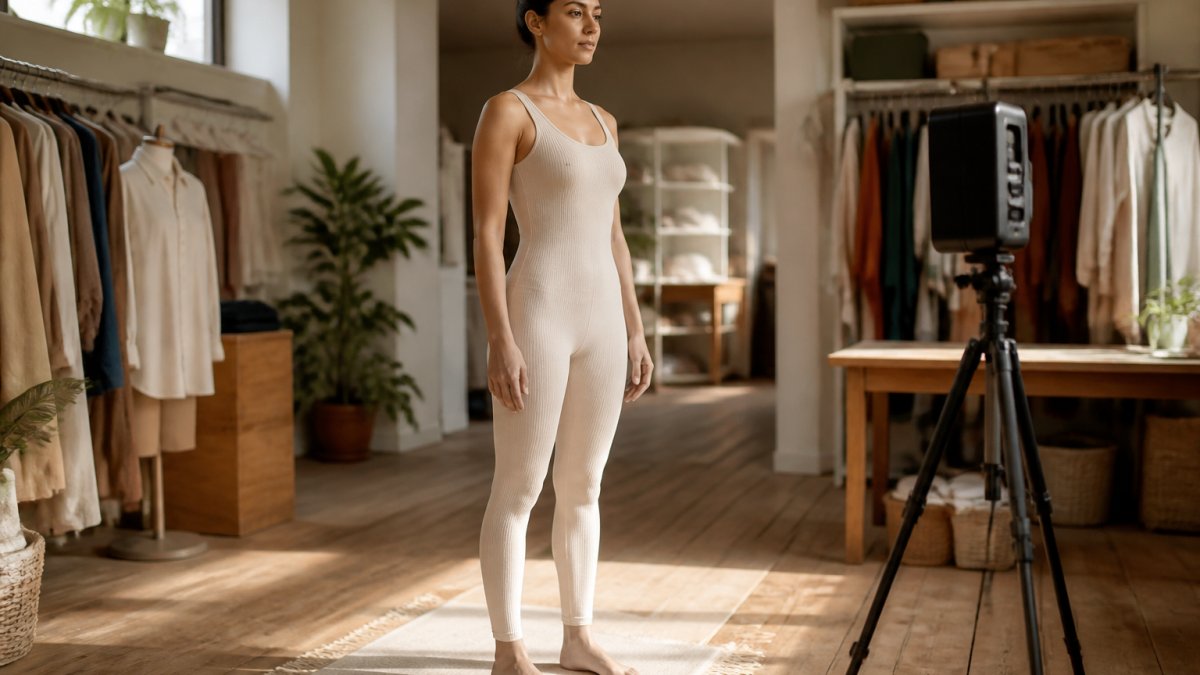
Posture matters significantly. Stand in a neutral position: feet shoulder-width apart, arms at your sides with a slight bend at the elbows, shoulders relaxed, head facing forward.
The environment also affects accuracy.
Optical scanning versus DEXA and other methods
Optical scanning, the most common method for clothing fit, uses cameras or structured light to capture your body's 3D shape.
DEXA scanning is different: a medical imaging technique using low-dose X-rays to measure bone density and body composition.
Hydrostatic weighing and other composition methods measure what your body is made of, not its shape, and for clothing fit you need shape and proportions.
3D Body Scanning for Clothing Fit: From Measurement to Recommendation
Once your 3D measurements are captured, the next step is translating them into garment recommendations, connecting your body data to the brand's fit specifications.
This is where machine learning comes in. A good system is trained on thousands of fit outcomes, which customers ordered which sizes and whether they kept or returned them.
When you get a recommendation, it's not just a size number.
How scan data connects to garment sizing
Your measurements become useful only when compared against garment specifications.
The algorithm compares your measurements against these. If your bust is 36 inches and a dress is cut with a 37-inch bust width, it will fit closely through the chest.
But raw measurements alone don't tell the whole story. Fit depends on how much excess fabric is appropriate for each garment type.
Accounting for fabric, style, and brand quirks
Different fabrics behave differently on the body. A stretchy knit accommodates a wider range of shapes than a rigid woven, and a fabric with natural drape sits differently than a stiff one.
Style matters too. A fitted wrap dress needs different proportions than a loose boyfriend shirt; skinny jeans have different requirements than wide-leg trousers. The system knows these categories and adjusts.
Brand quirks are real and persistent.
AI Body Measurements for Clothing: Accuracy and Repeatability
Scanning accuracy depends on the quality of the technology, the precision of the processing software, and the consistency of your positioning and clothing.
Sources of error do exist. Loose or wrinkled clothing adds apparent volume. Poor lighting creates distorting shadows.
The best way to ensure accuracy is consistency: wear the same type of fitted clothing each time, scan in the same location with the same lighting, and use the same posture.
Measurement accuracy and sources of error
Scanning accuracy is often compared to professional tailoring. A skilled tailor might be accurate to within a quarter inch; modern optical scanning can match that for most measurements, though some dimensions are harder to capture precisely.
Easy measurements include bust, waist, and hip circumference, the widest points, whose contours the software can clearly see.
Even if measurements vary slightly between scans, the algorithm learns which size recommendations actually result in satisfied customers, making the system strong to small measurement variations.
Consistency across repeated scans
Repeatability is more important than absolute accuracy for fit recommendations. If your measurements are consistently off by half an inch, the same half inch every time, recommendations remain accurate because the algorithm adjusts for the consistent bias.
Expect variation of about 0.5 inches between scans if you maintain consistent posture and clothing. Larger variation usually indicates a change in posture, clothing fit, or positioning.
Most people don't need to re-scan frequently. A single scan provides accurate recommendations for months.
Body Scan Privacy and Data Security: What Happens to Your Photos
This is the question that stops many people from using body scanning: where does your photo go, and who can see it?
Your body scan images are encrypted and stored securely on our servers. We do not share your images with third parties. We do not sell your data.
After your fit recommendations are generated, your images can be deleted.
How your data is stored and protected
Your scan images are encrypted using industry-standard encryption (AES-256 or equivalent), so even if our servers were compromised, the images would not be readable without the encryption key.
Your measurements, the numerical data extracted from your images, are stored separately from the images themselves, so even if someone gained access to your measurements, they couldn't reconstruct your image.
Data backups are encrypted and stored in secure data centers with physical access controls, retained for a limited period (typically 30 days) and then securely deleted.
Your rights and consent
You have the right to know what data we collect, how we use it, and how long we keep it, and to access, correct, or delete your data.
Before you upload your first scan, you'll be asked to consent to our privacy practices, and you can review our full privacy policy, which explains exactly what happens to your data.
Your body measurements, the numerical data, are much less sensitive than your images, measurements alone don't reveal your identity.
Body Scanning Works Across Body Types and Populations
One common concern is whether body scanning works equally well for all body types. The short answer is yes, modern systems are designed to capture any body shape.
If an algorithm has been trained primarily on standard body shapes, it may not perform as well for curvier figures, athletic builds, or other types that deviate from average.
Inclusive fit for curvier figures and between-size shoppers
People with curvier figures often struggle with sizing because standard charts assume a relatively consistent waist-to-hip ratio.
Body scanning solves this by measuring your actual proportions. If you have a 28-inch waist and 40-inch hips, the system knows that.
Between-size shoppers, people who fall between standard sizes, also benefit significantly. If you're a size 6 in some brands and a size 8 in others, it's because your proportions don't match the standard size ladder.
How often to update your scan
You don't need to update frequently. A single scan provides accurate recommendations for at least three to six months, assuming your body doesn't change significantly.
However, if you're actively working on fitness goals, building muscle, losing fat, or significantly changing your composition, more frequent scans can help you track progress and adjust sizing as your body changes.
Real Results: When Body Scanning Makes the Biggest Difference
Body scanning is most valuable where fit precision matters most.
Online-only brands benefit especially because customers can't try items on before buying. Traditional retailers have fitting rooms; online retailers don't.
It's also valuable if you shop across multiple brands regularly. If you buy from Zara, H&M, ASOS, and specialty brands, you've probably noticed sizing varies wildly.
High-stakes occasions and online-only brands
For a wedding dress, a bridesmaid dress, or any formal occasion, fit matters enormously.
Online-only brands like Asos, Boohoo, and Shein have made fashion more accessible, but their sizing can be inconsistent and hard to predict.
For people shopping internationally, body scanning is especially valuable. Different countries use different sizing systems, US, UK, EU, and Australian sizes are all different.
Downsides and when a scan isn't necessary
Body scanning isn't necessary for every purchase.
It also requires a bit of setup, proper lighting, appropriate clothing, and a camera or smartphone. It takes about five minutes.
There's also a learning curve. The first time you use body scanning, you're learning how the system works and how its recommendations apply to you.
Finally, body scanning is most accurate for standard garment types, dresses, shirts, pants, jackets.
Finding your perfect fit shouldn't require a closet full of returns and exchanges. With advances in optical scanning technology and AI-driven sizing systems, accurate fit recommendations are now accessible to anyone with a smartphone.
Frequently Asked Questions
How accurate are body scans for choosing clothing sizes?
Body scans capture circumference measurements, proportions, and body composition with precision that exceeds traditional sizing charts. Optical scanning systems record hundreds of data points across your torso, arms, and legs. Accuracy depends on proper posture, appropriate clothing, and consistent lighting during the scan. Most systems achieve repeatability within 1-2 centimetres across multiple scans, making them far more reliable than BMI or generic size charts for predicting how individual garments will fit your unique body shape.
How does body scanning improve clothing fit compared to size charts?
Size charts assume a standard body shape within each size, but real bodies vary widely in proportions. Body scanning measures your actual shoulder width, chest circumference, arm length, and torso proportions, then matches these to how specific brands cut their garments. This accounts for the fact that a medium at Zara fits differently than a medium at H&M. By learning your precise measurements and how different fabrics and styles interact with your body shape, scanning eliminates the guesswork and reduces returns from poor fit.
What should I wear when taking a body scan for clothing measurements?
Wear fitted, light-colored clothing such as a fitted t-shirt and leggings or fitted shorts. Avoid loose layers, baggy clothing, or dark colours, which obscure your body's true outline and confuse the scanning software. Stand in a neutral, upright posture with your arms slightly away from your sides. Ensure the space is well-lit and you're positioned at the correct distance from the camera or scanner. Consistency in clothing and posture across scans ensures your measurements remain accurate and comparable over time.
Is my body scan data secure, and where is it stored?
Reputable body scanning platforms encrypt your photos and measurements, storing them on secure servers with restricted access. Your full-body images should never be shared with third parties without explicit consent, and you should have the right to delete your data at any time. Before using any scanning service, review their privacy policy to confirm how long they retain images, who can access them, and whether they use your data to train their AI models. Always choose platforms that clearly outline these protections.
How often should I update my body scan for clothing fit?
Update your scan whenever your body composition changes noticeably, typically every 3-6 months if you're actively training or losing fat, or annually for maintenance. Seasonal weight fluctuations, muscle gain from training, or changes in posture can shift your measurements by several centimetres. If you're shopping for a one-time occasion and your body hasn't changed since your last scan, a single scan is sufficient. Tracking changes over time also helps you see how your fitness goals are progressing beyond what a scale shows.
Does body scanning work for different body types, or just standard sizes?
Modern body scanning technology is designed to work across all body types, including curvier figures, athletic builds, and bodies that fall between standard sizes. The system measures your unique proportions, not just weight or BMI, so it accounts for how fabric drapes on different body shapes. If you're consistently between sizes or have a non-standard silhouette, scanning is especially valuable because it identifies which size works best for your specific proportions across different brands and styles, rather than forcing you into a generic category.
How does AI use body measurements to recommend clothing sizes?
AI analyzes your scan data alongside a brand's sizing specifications and garment construction details. The system learns how that brand's fabrics stretch, how their cuts are designed, and which measurements matter most for fit (shoulder width, chest, waist, hip, inseam). It then compares your measurements to thousands of past fits to predict which size will work best for you in that specific garment. Over time, the AI improves its recommendations by learning from your feedback on whether recommended sizes actually fit well.
What are the downsides of using a body scan for fit recommendations?
Body scans work best for standard cuts and established brands with consistent sizing. They're less reliable for highly experimental designs, bespoke tailoring, or brands with significant batch-to-batch variation. Scans also cannot account for personal style preferences, how tight or loose you prefer a fit. If you have unusual proportions, the AI may struggle to find comparable fits in its database. Additionally, scans require proper setup (correct clothing, lighting, posture), and some users find uploading photos uncomfortable despite privacy protections.