 blog
blog
Best Sizing Apps for Curvy Figures: 2026 Guide
Table of Contents
- Why Sizing Apps Matter for Curvy Shoppers
- How to Measure Your Body for Clothes Accurately
- Virtual Fitting Room Software: What Actually Works
- Key Features to Look For in Sizing Apps
- Reducing E-Commerce Returns for Retailers Through Fit Technology
- Privacy and Data Security in Body-Centric Apps
- Making the Right Choice for Your Shopping Needs
- Frequently Asked Questions
Last Updated: October 2, 2026
Why Sizing Apps Matter for Curvy Shoppers
Finding clothes that fit well is frustrating for anyone, but curvy shoppers face a distinct problem: standard sizing charts don't account for the variety of body shapes and proportions beyond conventional sizes, which is why the best sizing apps for curvy figures have become essential tools. This creates a cycle of buying, receiving ill-fitting items, and returning them.
Best sizing apps for curvy figures solve this by bridging the gap between your actual measurements and what retailers' size charts actually mean. They use technology to match your body to specific garments, eliminating the guesswork that leads to returns and wasted time.
When you know exactly which size works for your body across different brands and styles, online shopping becomes reliable instead of risky. This matters because curvy shoppers typically face higher return rates and more time spent hunting for pieces that actually fit.
Most sizing apps were built for standard body types first, then adapted for curvy figures as an afterthought.
How to Measure Your Body for Clothes Accurately
Accurate measurements are the foundation of any sizing recommendation. Most people measure themselves incorrectly because they don't know what "accurate" actually means in this context.
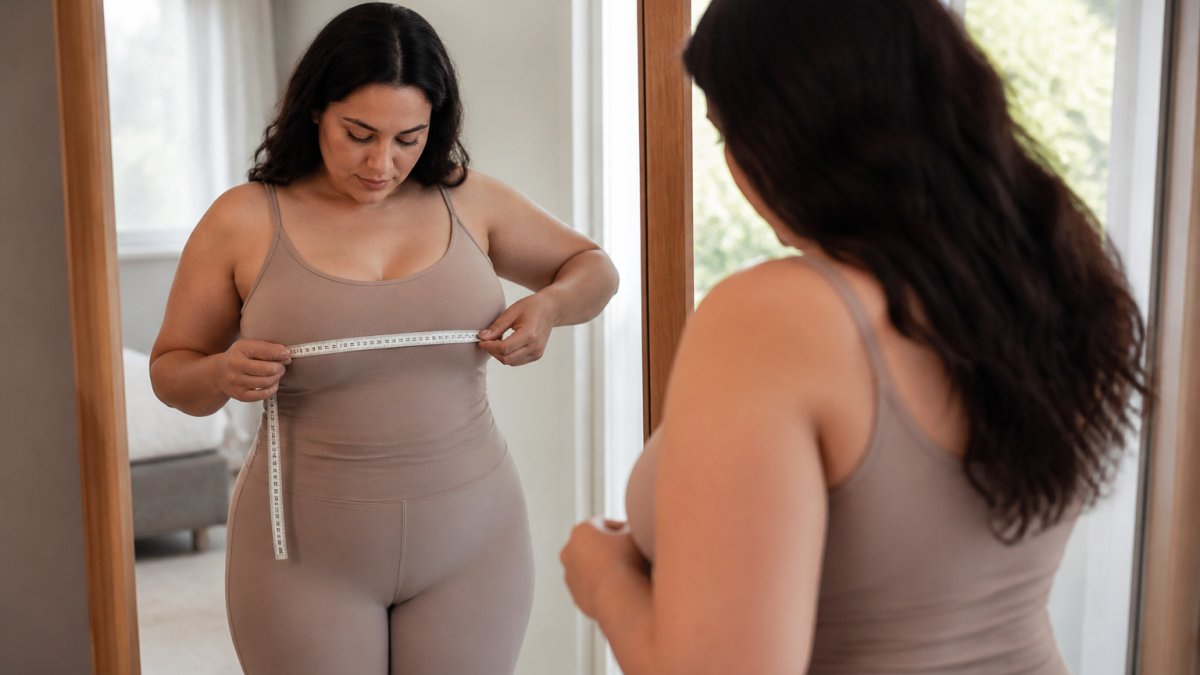
Start with a soft measuring tape, not a rigid ruler. Stand in front of a mirror in fitted clothing that shows your actual shape, not loose sweats, not compression wear. You need to see where your body actually sits. Take measurements at key points: bust (across the fullest part), waist (at your natural waist line, not where your pants sit), hips (at the fullest point), and inseam (from your inner thigh to your ankle).
The critical mistake is pulling the tape too tight or too loose. The tape should sit snugly against your skin but not compress it. Take each measurement twice to verify accuracy.
For curvy figures, how your bust and hip measurements relate to each other matters most. A 36-inch bust with 42-inch hips creates different fit needs than a 40-inch bust with 42-inch hips, even though the hip measurement is identical. Generic size charts fail because they assume proportional relationships that don't exist across curvy body types.
Write down every measurement and keep it accessible. Many sizing apps let you save this data, so you only measure once and every subsequent recommendation becomes faster and more accurate.
Virtual Fitting Room Software: What Actually Works
Virtual fitting room technology ranges from genuinely useful to misleading. The critical distinction is understanding how these systems handle the complexity of curvy body shapes and where they fail.
How AI Sizing Accuracy Works for Curvy Bodies
Photo-based AI systems analyze your silhouette by mapping key body landmarks: shoulder width, bust apex, waist position, hip fullness, and torso-to-leg ratio. For curvy figures, curves create non-linear relationships between measurements that require different garment engineering.
The best systems train on large datasets of curvy body types and learn how fabric stretch behaves on fuller busts, how princess seams sit on pronounced curves, and how inseam length interacts with hip fullness. Systems trained primarily on straight-size bodies miss these interactions.
The Limits of Photo Analysis
Photo-based systems work best in consistent lighting and fitted clothing that shows your actual shape. Loose clothing, poor lighting, or unusual angles degrade accuracy. Some systems ask for multiple angles, which increases setup time but improves reliability.
Photos capture a single moment.
For curvy shoppers, body composition shifts affect fit more dramatically on curves. An app using a single photo from six months ago may give increasingly inaccurate recommendations.
Measurement Input Methods and Their Trade-Offs
Measurement-only systems are faster to set up but require you to understand your proportions. They work well if you know how brands fit you, but fail when trying new brands or styles.
The hybrid approach, combining photo analysis with manual measurements, gives the most complete picture.
Evaluating Claims About Accuracy
Be skeptical of apps claiming 95%+ accuracy rates. Fit is subjective.
The most transparent apps explain that fit depends on your personal preferences, the garment's construction quality, and how that brand's sizing has evolved.
Key Features to Look For in Sizing Apps
Look for tools that offer specific garment recommendations, not just size numbers. "You're a size 14" is useless if you don't know what that means across different brands.
The best apps provide fabric-specific guidance. A size 14 in stretchy jersey fits completely differently than a size 14 in rigid denim.
Cross-brand consistency matters. You might be a size 12 at one retailer and a size 16 at another.
| Feature | Why It Matters for Curvy Shoppers | Red Flag |
|---|---|---|
| Fabric-specific recommendations | Different materials behave differently on curves | Generic size only |
| Cross-brand sizing data | Brands fit inconsistently | Single-brand focus |
| Photo-based analysis | Captures actual silhouette | Measurement-only input |
| Curvy community reviews | Feedback from similar bodies | Generic reviews |
| Style-specific guidance | Cut affects fit more than size | One-size-fits-all approach |
Reducing E-Commerce Returns for Retailers Through Fit Technology
From a retailer's perspective, sizing apps solve a massive business problem. Returns due to fit issues cost money, not just in shipping and processing, but in lost customer lifetime value. When someone receives an item that doesn't fit, they're frustrated. They're less likely to buy from that retailer again.
Retailers using virtual fitting room software see measurable improvement in fit satisfaction and lower return rates.
When retailers understand their customer base's actual measurements and fit preferences, they design better products.
Privacy and Data Security in Body-Centric Apps
Uploading full-body photos raises legitimate privacy concerns. Your body measurements and images could be misused in ways that enable body-shaming, discrimination, or exploitation. You need to understand how apps store and use your data.
The Specific Risks of Body-Data Apps
Body-centric apps collect data beyond typical personal information. A photo of your body combined with measurements and shopping history creates a detailed profile valuable to retailers, AI training companies, and advertisers, and vulnerable to misuse.
For curvy shoppers, there's an additional risk: body-shaming. If an app's data is breached or sold, your body measurements could be used in weight-loss marketing or other contexts that assume your size is a problem.
Another risk is algorithmic discrimination. If an app was trained primarily on straight-size bodies, it might systematically underestimate sizes for curvy figures or steer you toward unflattering styles.
Questions to Ask Before Uploading Photos
Data retention: Does the app delete your photos after analysis or store them? If stored, for how long, and can you request deletion? You should know the app's policy.
Third-party sharing: Will the app share your measurements, photos, or body data with retailers, advertisers, or AI training companies? Vague language like "we may share anonymized data" is a red flag.
AI training: Is your data used to train the app's sizing AI? Is that opt-in or automatic? The app should let you choose.
Breach liability: If the app is hacked, what's the company's liability? Check whether they carry cyber insurance and commit to notifying you within a specific timeframe (typically 30 days) if your data is compromised.
International data transfer: If the app is based in a different country, where is your data stored? If you're in the EU, the app should comply with GDPR (Data protection under GDPR). If you're in California, it should comply with CCPA.
Evaluating Privacy Policies
Data collection: What exactly does the app collect? The more data collected, the higher the risk.
Data use: What does the app do with your data?
Red Flags to Avoid
Do not use an app if: the privacy policy is missing or vague; the company has a history of privacy violations; the app requires sharing data with third parties to use it; it collects unnecessary data; the company is based in a jurisdiction with weak privacy laws; or it refuses to delete your photos when requested.
Trustworthy Alternatives
The best apps publish privacy policies in plain language, offer privacy-first options with minimal data collection, are owned by established companies with public privacy commitments, allow you to download or delete your data with a single click, and explicitly state they will never sell body data to third parties.
Making the Right Choice for Your Shopping Needs
Choosing the right sizing app depends on your specific situation. If you shop across many brands, you need an app that tracks cross-brand sizing patterns. If you're buying for specific occasions, you want detailed garment-specific recommendations.
Frequently Asked Questions
How accurate are sizing apps for curvy figures?
Sizing apps designed for curvy shoppers use AI to analyze your unique body shape and proportions. Accuracy depends on the quality of your measurements and the app's database of brand-specific sizing data. Apps that incorporate full-body photo analysis tend to perform better for curvy figures because they account for how garments fit across different body zones rather than relying on standard measurements alone.
Can sizing apps account for different body types and measurements?
The best sizing apps for curvy figures are built with inclusive design from the ground up. They recognize that curvy bodies don't fit standard sizing formulas, they use algorithms trained on diverse body shapes, measure multiple points (bust, waist, hip, length), and factor in fabric stretch and garment construction. This approach helps them provide tailored recommendations regardless of where you fall on the size spectrum.
What happens to my photos and measurements when I use a sizing app?
Data privacy varies by app. Before uploading full-body photos, check the app's privacy policy to understand how images are stored, whether they're encrypted, and if they're deleted after analysis. Reputable sizing apps use end-to-end encryption and don't retain images longer than necessary. Some apps allow you to delete your data at any time. Always verify these protections before sharing body-centric information.
Do sizing apps work across different brands with different fit standards?
Top sizing apps maintain databases of how specific brands fit, accounting for the fact that a size 12 at one retailer may fit differently than at another. However, smaller or newer brands may not be in the database yet.
Finding clothes that fit shouldn't require a guessing game. When you use the right sizing technology, online shopping becomes straightforward instead of frustrating. Fit Perfect AI helps you match your measurements to specific garments across brands and styles, so you know before you buy. Register today to start getting sizing recommendations tailored to your unique body type.