 blog
Are There Better Options Than Manual Size Guides?
Last Updated: October 30, 2026
Quick Summary
Better options than manual size guides include clothing size calculators, AI recommendation tools, interactive size charts and virtual fitting rooms. Each reduces the shopper's manual work, though they differ in how much personal data they collect and how much setup they require.
- Static charts require shoppers to measure themselves and convert units, which often leads to errors.
- Clothing size calculators turn a few body measurements into a single suggested size.
- AI tools can store fit data per garment and may improve as return data comes in.
- AI and virtual fitting tools may collect photos or measurements, so privacy questions must be answered first.
- Pilot any new sizing tool on best-selling items and measure return rates before expanding.
Table of Contents
- Why Static Size Guides Fall Short for Online Shoppers
- Clothing Size Calculators: How They Work and Where They Help
- AI Clothing Size Recommendation Tools Compared to Standard Charts
- Interactive Size Chart for E-Commerce: Features Worth Looking For
- Virtual Fitting Room for Online Shopping and Body-Measurement Approaches
- Data, Privacy and Implementation Considerations for Retailers
- Choosing a Sizing Approach for Your Store or Your Next Purchase
- Frequently Asked Questions
Why Static Size Guides Fall Short for Online Shoppers
Static size charts ask shoppers to do the hardest part themselves. They have to measure their bust, waist and hips, then match those numbers to a table that often differs from one brand to the next.
Many shoppers find that a size that works in one store runs small or large in another. A common approach from retailers is to add more chart detail, but that adds more numbers for the shopper to interpret. Compare two leading AI sizing tools head to head to see how they differ in practice.
Common problems with static charts include:
- Measurements taken incorrectly or skipped entirely
- Charts that list garment dimensions instead of body dimensions
- No guidance on stretch, fit style or intended ease
- Different sizing standards across brands and regions
Watch out: a chart that looks precise can still mislead. A shopper who measures carefully but compares against the wrong brand's table is likely to order the wrong size.
Clothing Size Calculators: How They Work and Where They Help
A clothing size calculator asks the shopper for a few body measurements or a height and weight, then suggests a size based on a stored sizing model. It is a step up from a static chart because it turns the shopper's inputs into a single recommendation instead of a table to read. Many retailers offer one on the product page.
Calculators help most with straightforward cuts and shoppers who already know their measurements. They are less reliable for garments with unusual fits, and they usually cannot account for how a specific fabric stretches. For most people, a calculator is a fast first filter rather than a final answer.
AI Clothing Size Recommendation Tools Compared to Standard Charts
AI recommendation tools sit at the far end of the spectrum from a static chart. Where a chart asks the shopper to interpret numbers, an AI tool tries to remove that interpretation step entirely.
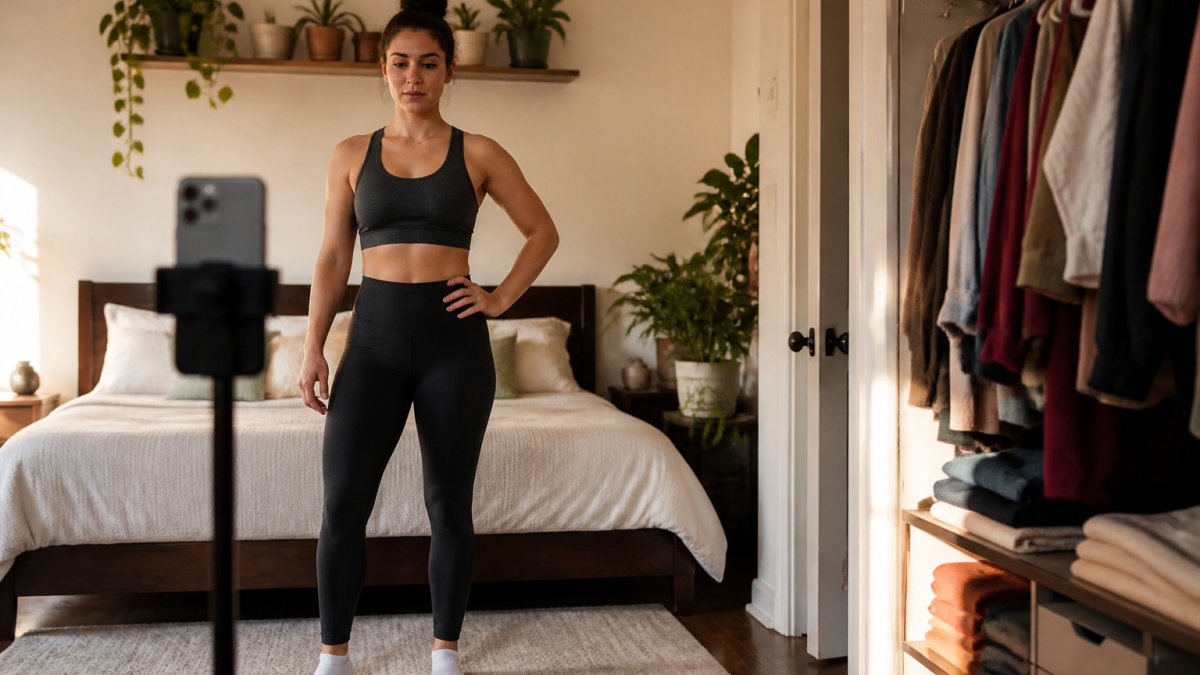
Compared with a standard chart, the practical differences are:
- Input burden: A chart requires the shopper to measure themselves and convert units. An AI tool may ask for a photo, a few measurements, or nothing beyond past order data.
- Garment specificity: A chart is usually one table per brand or category. A well-built AI tool stores fit data per garment, including fabric stretch, cut, and intended ease.
- Feedback loop: Charts are static. AI tools can improve as return and exchange data comes in, though only if the retailer feeds that data back.
- Data sensitivity: A chart collects nothing. An AI tool may collect body measurements, photos, or purchase history, which raises consent and retention questions.
Fit Perfect AI uses full-body photo uploads to provide sizing recommendations for each garment, fabric, and style. Shoppers who find tape-measure instructions confusing may find this approach easier, but image handling should be clear to the shopper.
Watch out: an AI tool is only as good as the sizing data behind it.
For shoppers, the trade-off is straightforward: an AI tool asks for less manual work but more personal data. For retailers, the trade-off is setup effort and data governance against the potential for fewer sizing returns. Neither side should treat an AI recommendation as infallible, it is a stronger first filter than a chart, not a guarantee.
The main differences between a standard size chart and an AI recommendation tool come down to these points.
| Factor | Standard chart | AI tool |
|---|---|---|
| Input burden | Shopper measures and converts units | May ask for a photo or a few measurements |
| Garment specificity | One table per brand or category | Fit data stored per garment |
| Feedback loop | Static | Can improve with return and exchange data |
| Data sensitivity | Collects nothing | May collect measurements, photos or purchase history |
Interactive Size Chart for E-Commerce: Features Worth Looking For
An interactive size chart goes beyond a static table by letting the shopper switch units, highlight their measurements or see how a garment should sit on their body. These features reduce confusion without asking the shopper to abandon the product page.
Look for these features when you evaluate an interactive chart:
- Unit switching between centimetres and inches
- Garment measurements alongside body measurements
- Fit notes for stretch, ease and intended wear
- Mobile-friendly layout that works on a small screen
- Clear guidance for shoppers who fall between two sizes
Virtual Fitting Room for Online Shopping and Body-Measurement Approaches
A virtual fitting room lets a shopper see how a garment might look on a body that resembles theirs. Body-measurement approaches sit in the same family. They estimate size from measurements or images rather than from a chart the shopper reads alone. The goal is the same as a calculator or AI tool: a more confident choice before checkout.
Virtual fitting is still developing. It can show overall proportions well but may miss how a fabric moves or how a garment fits around specific areas. Many shoppers find it most useful as a preview of silhouette and length rather than as an exact size prediction.
Data, Privacy and Implementation Considerations for Retailers
This section covers the practical decision factors, what data a sizing tool needs, how it is governed, and how much setup it takes, so you can evaluate any alternative to a manual size guide.
What data does the tool require?
Sizing tools fall into a few data tiers:
- No personal data: Static or interactive charts that the shopper reads without entering measurements.
- Measurement data: Calculators that ask for bust, waist, hips, height, or weight.
- Photo or body-scan data: Virtual fitting and AI tools that estimate size from images or scans.
- Behavioural data: Tools that use past orders, returns, or browsing to refine recommendations.
Each tier carries different obligations. Photo and body-scan data is the most sensitive and should be treated accordingly. Find out how clothing size data is secured and handled to understand what safeguards to expect.
Privacy questions to ask before launch
- Where is shopper data stored, and in which jurisdiction?
- How long is it retained, and can a shopper request deletion?
- Is data shared with third parties, and is that disclosed in the privacy policy?
- Is consent collected before any photo or measurement is uploaded?
- Does the tool work without collecting data the retailer does not need?
Retailers should review the official guidance for their market before launch. Learn how to tell whether AI body scanning is safe for privacy before you collect any shopper photos or measurements. In the UK, the Information Commissioner's Office guidance on biometric and personal data is a sensible starting point. In the EU, GDPR obligations apply to body measurements and images that can identify a person.
Implementation effort by approach
- Static chart improvements: Low effort. Update copy, add fit notes, and check unit consistency. No integration work.
- Interactive chart: Moderate effort. Requires mapping garment measurements to the chart widget and testing on mobile.
- Calculator: Moderate to high. Needs a sizing model per category and a way to keep it updated as products change.
- AI or virtual fitting: High. Requires catalogue integration, garment measurement mapping, testing on real products, and a data governance process.
A common pattern is to pilot on best-selling items first, measure return rates by category, and expand only if the results justify the setup cost.
Accessibility and inclusive sizing
If a sizing tool replaces a text chart, keep a text alternative for screen-reader users. The W3C Web Content Accessibility Guidelines set the baseline. Also check that extended sizes and diverse body types are represented in the tool's recommendations, a sizing model trained on a narrow size range will underperform for the shoppers who need help most.
Platform-neutral evaluation
Many visible comparisons are Shopify-specific. If you are on WooCommerce, BigCommerce, Magento, or a custom stack, confirm the tool offers a platform-agnostic integration (API, JavaScript widget, or product feed) rather than a single-platform app. Ask about ongoing maintenance too: garment data changes, new categories, and seasonal ranges all require updates, and the tool should make that work manageable without a developer.
Choosing a Sizing Approach for Your Store or Your Next Purchase
The right approach depends on what you are solving. A small store with a simple catalogue may do well with a clear, well-written static chart and fit notes. A shopper who already knows their size can rely on reviews and the chart and skip the extra tools. Read a practical fit guide on how to stop returning clothes once you have settled on an approach.
Use this quick guide to decide:
- Few products, simple cuts: Improve the static chart and add fit notes
- Frequent sizing returns: Test an AI recommendation or calculator on your best-selling items
- Mixed catalogue, many brands: Choose a tool that handles varied fits and fabrics
- Shopper with known sizes: Check the chart and read customer reviews
Fit Perfect AI is built for shoppers and retailers who want a precise recommendation without the guesswork of a manual chart. To see how it works for your situation, see how Fit Perfect AI recommends sizes from a full-body photo. If you want to compare it against other options first, read our clothing size calculator guide before you decide.
Frequently Asked Questions
What are the alternatives to manual size guides for e-commerce?
The main alternatives are clothing size calculators that ask for a few body measurements, AI clothing size recommendation tools that estimate fit from body data or photos, interactive size charts that adjust to the shopper's inputs, and virtual fitting room tools that show how a garment might sit on a body shape. Each approach replaces a static table with a personalised recommendation, which can reduce guesswork when brands size differently. Retailers usually combine one of these tools with the existing size chart so shoppers can still compare the raw measurements themselves.
How accurate are AI clothing size recommendation tools compared to standard charts?
Accuracy depends on the quality of the body data, the garment data the tool is trained on, and how consistently a brand sizes its products. Standard charts give one fixed set of measurements for every shopper, so they cannot account for differences in body shape between two people with the same bust or waist figure. AI tools can factor in several measurements and garment specifications at once, which can help shoppers who sit between sizes. Results still vary by brand, so it is worth checking how a tool performs for the specific retailers you shop with.
Do I need to upload photos every time I want a size recommendation?
This depends on the tool. Some sizing services save a shopper's profile so measurements can be reused across purchases, while others ask for new inputs each time. Check whether your saved profile carries over between retailers that use the same tool, and whether you can edit or delete your stored data. Asking this before you start helps you decide whether a one-time setup is worth the time it saves on each later purchase.
How can online stores reduce sizing uncertainty and returns?
Stores can reduce sizing uncertainty by offering an interactive size tool alongside a clear size chart, including measurements in both centimetres and inches, and showing how each garment fits relative to the shopper's body measurements. Adding fit notes from real customers and clarifying how a brand sizes compared with others also helps. Any tool should be tested with real shoppers before rollout, and its impact on return rates should be tracked rather than assumed.
Sizing returns cost time and money, and a better fit starts before checkout. Register with Fit Perfect AI to get size recommendations for every garment, fabric and style, and start choosing with more confidence.