 blog
Is There an AI Measuring Tool? 2026 Guide
Table of Contents
- What Is an AI Measuring Tool?
- How AI Body Measurement Apps Work
- Taking Body Measurements From Photos
- How Accurate Are AI Body Measurements?
- Body Measurement Privacy and Data Security
- When AI Measuring Tools Fall Short
- Frequently Asked Questions
Last Updated: October 21, 2026
What Is an AI Measuring Tool?
An AI measuring tool is software that uses artificial intelligence and computer vision to take precise measurements from photos or video. You upload an image, the AI analyzes it, and delivers dimension estimates without needing physical measuring devices. These tools work across different use cases: body measurements for apparel sizing, room dimensions for flooring or furniture, construction estimates for contractors, or product dimensions for e-commerce returns.
The core technology relies on image analysis and pattern recognition. The AI learns to identify reference points in photos, your shoulders, waist, limbs, or room corners, and calculates dimensions based on those landmarks. FitScan AI is an innovative solution designed to help you find your perfect fit with ease. By simply uploading full-body photos, users receive precise sizing recommendations tailored to every garment, fabric, and style. This technology streamlines the shopping experience, ensuring you always select the right size for your unique body type.
What makes this different from traditional measuring is speed and convenience. You don't need a tape measure, a second person, or a fitting room. The process takes seconds. For online shoppers who struggle with inconsistent sizing across brands, this removes a major friction point in the buying decision.
How AI Body Measurement Apps Work
Body measurement apps follow a consistent workflow: capture, analyze, recommend. First, you photograph yourself from the front and sometimes the side or back. The app uses computer vision to detect key body landmarks, shoulders, chest, waist, hips, inseam. From those points, it calculates body dimensions and generates a digital profile.
The AI then compares your measurements against a database of sizing standards from different brands. Zara sizes differently than H&M. Target differs from ASOS. The system learns these quirks and translates your body data into specific size recommendations for each retailer. This is where the real value emerges: not just knowing your measurements, but knowing what size to buy here versus there.
Most apps store your profile after the first upload. Subsequent measurements are faster because the system already knows your baseline.
Taking Body Measurements From Photos
Getting usable measurements from photos requires specific conditions. Start with a clear, full-body shot taken straight-on. You should be visible from head to toe, wearing fitted clothing that shows your actual body shape. Baggy clothes confuse the AI because it can't see your actual dimensions.
Lighting matters significantly. Natural daylight or bright indoor lighting works best. Shadows, backlighting, or low-light conditions create measurement errors. The AI needs to see your body clearly to identify landmarks accurately.
Distance and framing also affect results. Stand far enough from the camera that your entire body fits in the frame without distortion. If you're too close, the camera's perspective distorts your proportions. If you're too far, detail is lost.
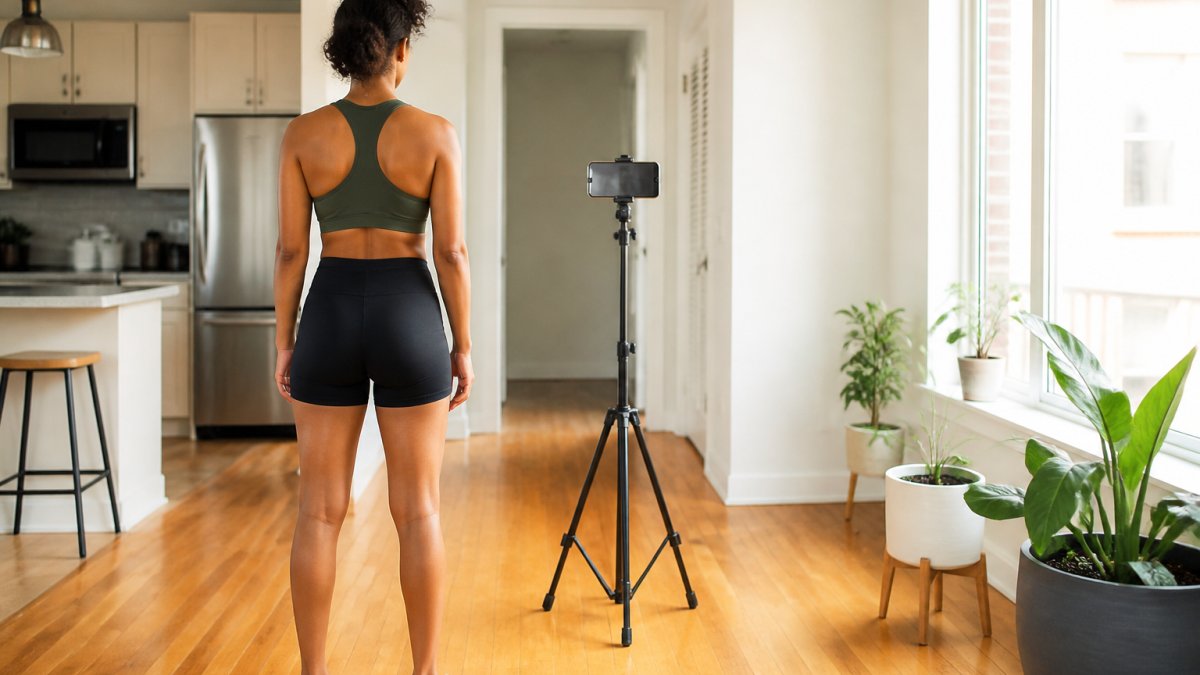
Consistency matters if you're retaking measurements. Use the same location, lighting, and clothing type each time. Changes in these variables introduce measurement variance that has nothing to do with your actual body.
How Accurate Are AI Body Measurements?
Accuracy is the question every skeptical shopper asks first, and it deserves a concrete answer rather than a hedge. The honest answer has three parts: accuracy depends on the measurement type, the input quality, and whether the tool publishes any validation evidence at all.
Start with the measurement type. AI measurement tools do not have one accuracy number. They have a range that shifts by task:
- Static object and room dimensions (a wall, a floor, a piece of furniture) tend to be the most reliable because the reference points are rigid and well-defined. A corner does not change shape between photos.
- Body measurements are harder because posture, breathing, clothing, and camera angle all move the landmarks the AI is trying to detect. A 1-inch shift in shoulder position can change a chest or sleeve estimate.
- Soft or draped items (fabric, curtains, loose garments) are the least reliable because the AI is estimating a boundary that is not physically fixed.
Then look at input quality. Most practitioners find that photo quality dominates the error budget. A well-lit, straight-on, full-body photo with a visible scale reference will usually produce tighter estimates than a dim, angled, cropped photo, even on the same tool. This is why device, lighting, and framing requirements matter more than the brand name on the app.
Then ask what the tool actually publishes. This is where the market is thin.
A practical way to read accuracy claims:
- Is the error stated as a range or a single number? A range with a stated confidence (e.g., 'most measurements within X') is more credible than a bare 'accurate to the inch.'
- Is the validation independent? Manufacturer-run testing is common; third-party or academic validation is rare and worth more when you can find it.
- Does the tool report error by measurement? Waist and inseam are typically harder than shoulder width. A tool that reports one blended number is hiding the hard cases.
- Does it state its failure conditions? A tool that names its own limits (loose clothing, reflective backgrounds, extreme body types) is usually more trustworthy than one that claims universal accuracy.
What this means in practice. Treat any AI body measurement as an estimate with a real error band, not a precision instrument. For casual online shopping, an error band is often acceptable because brands themselves vary by more than that between sizes. For high-stakes fits, a suit, a wedding dress, a uniform, the error band is large enough that you should verify with a tape measure or a professional fitting before committing.
If you want a single rule: trust the tool that tells you how it measured its accuracy and when it fails, not the one that only tells you how good it is.
Body Measurement Privacy and Data Security
Uploading full-body photos to any app creates legitimate privacy concerns. Where does that image go? Who can access it? How long is it stored?
Different tools handle this differently. Some delete photos immediately after analysis. Others store them to improve their AI models over time. A few sell anonymized data to third parties. Most reputable tools offer privacy policies that spell out their practices, but reading the fine print is essential.
Look for these specific protections: encryption during upload and storage, clear deletion policies, and explicit statements about whether your photos are used for model training. If a company doesn't clearly state what happens to your images, assume the worst and find an alternative.
Consent matters too. Some tools ask permission to use your anonymized data for improvement. Others do it by default. Read the permissions screen carefully. You control what data you share.
For sensitive use cases, medical measurements, body scanning for insurance or legal purposes, privacy becomes critical. Standard consumer apps may not meet the security standards required for those applications.
When AI Measuring Tools Fall Short
AI measurement tools are useful but not universal, and the most valuable thing a buyer can know is the point at which the tool stops being the right instrument. Competitors rarely say this plainly, so here is a practical decision guide.
The tool is the wrong choice when the measurement is the product. If the number itself is the deliverable, a custom-tailored garment, a medical or insurance measurement, a legal or safety-critical dimension, a construction cut list, an AI estimate is not a substitute for a calibrated instrument and a human check. Use AI to pre-screen or speed up intake, then verify with a tape measure, laser measure, or professional fitting. The cost of a wrong number in these contexts is higher than the time saved.
The tool is unreliable when the scene breaks its assumptions. Most computer-vision measurement tools assume a reasonably plain background, even lighting, a straight-on camera, and a visible scale reference. They degrade in predictable conditions:
- Reflective or mirrored surfaces, mirrors, glass, polished floors, create duplicate edges the model can mistake for real boundaries.
- Busy or patterned backgrounds, the model may latch onto pattern edges instead of the object or body outline.
- Extreme camera angles, a photo taken from above or below introduces perspective distortion that the model may not correct for, inflating or shrinking dimensions.
- Poor or uneven lighting, shadows read as edges; backlighting erases the silhouette the model needs.
- No scale reference, without a known-size object or a stated camera distance, absolute dimensions become a guess even when relative proportions are correct.
The tool is unreliable when the subject is outside its training distribution. A model trained mostly on standard adult body types will tend to underperform on very tall or short individuals, very muscular builds, significant weight change, or bodies with features that confuse landmark detection (heavy tattooing, scarring, prosthetics, compression garments). This is not a moral failing of the tool, it is a data-coverage limit, but it means you should not assume the same accuracy you see in a demo.
The tool cannot capture preference or material behavior. AI gives a size based on average fit standards. It does not know whether you like a snug or relaxed fit, and most tools do not model fabric stretch, weight, or drape. A knit and a woven garment with identical measurements will fit differently; the AI may recommend the same size for both. For anything where drape or stretch matters, treat the AI size as a starting point and check the brand's fabric notes and return policy.
A simple decision rule:
- Use AI measurement when the decision is low-stakes, reversible, and the input conditions are good (plain background, even light, straight-on photo, scale reference).
- Verify manually when the decision is high-stakes, non-returnable, or the input conditions are poor.
- Skip AI entirely when a calibrated instrument or a professional is required by the context (medical, legal, safety-critical, custom tailoring).
For professional use, tailoring, medical measurement, construction estimates, AI tools are supplements, not replacements for human expertise. They are fast and convenient for casual shopping decisions and less reliable for high-precision applications.
Frequently Asked Questions
Is there an AI tool that can measure your body from a photo?
Yes. AI measuring tools use computer vision and machine learning to analyze full-body photos and estimate body dimensions. These tools capture measurements like bust, waist, hip, and inseam without physical contact. They're designed specifically for apparel sizing, allowing shoppers to receive personalized garment recommendations based on their unique body shape and proportions.
How accurate are AI body measurement tools?
Accuracy varies by tool and conditions. Most AI body measurement apps achieve estimates within a certain range of actual measurements when photos meet quality standards: high resolution, full-body visibility, neutral lighting, and minimal clothing. Results depend heavily on photo angle, distance from camera, and body positioning. Tools work best for general sizing guidance rather than precision tailoring.
Are AI body measurement apps safe and private?
Privacy depends on the provider's data handling practices. Before uploading photos, check whether the app stores images, how long they're retained, and whether they're used for training or shared with third parties. Reputable tools encrypt data in transit and allow users to delete photos after measurement. Always review the privacy policy and terms of service to understand exactly what happens to your images.
What photos do you need for an AI body scan?
Most AI measuring tools require high-resolution full-body photos. Photos should show your entire body from head to toe, taken in natural or bright artificial lighting to minimize shadows. Wear fitted clothing or minimal clothing to allow the AI to see your body outline clearly. Stand straight with arms slightly away from your body for the most accurate measurement capture.