 ultimate-guide
Why Online Size Charts Fail: A 2026 Guide
Last Updated: October 23, 2026
Quick Summary
Online size charts fail because they were designed for standardization that no longer exists in today's fragmented retail landscape. A size Large can span 14cm of waistline variation depending on the manufacturer, and up to 70% of apparel returns are driven by sizing data fragmentation and fit issues.
- A size Large can range from 94cm to 108cm waistline across different brands, a 14cm gap that determines fit.
- Up to 70% of apparel returns are driven by sizing inconsistencies, translating to roughly 30 dollars per returned item in costs.
- Over 80% of shoppers believe size charts are inconsistent, and online apparel returns hit 24.4% with poor fit driving over half.
- Brands use vanity sizing strategically, labeling garments with smaller sizes than measurements warrant to improve conversion rates.
- Finished-garment measurements and ease vary by brand, and fabric stretch percentage can compensate for or expose sizing errors.
Table of Contents
- Why Online Size Charts Fail: The Core Problem
- The 14cm Problem: Why a Large Isn't Always a Large
- Vanity Sizing Explained: Why Brands Manipulate Size Labels
- Body Measurements vs. Garment Measurements: The Critical Distinction
- How to Measure Yourself for Clothes: A Practical Method
- Using a Clothing Size Calculator to Navigate Inconsistency
- The Hidden Factors Size Charts Ignore
- Frequently Asked Questions
Why Online Size Charts Fail: The Core Problem
Online size charts fail because they were designed for a problem that no longer exists. Decades ago, when mail-order catalogs first needed to communicate sizing, standardization made sense. Today's fragmented retail landscape has shattered that assumption.
The core issue isn't that size charts are poorly designed. It's that the entire premise is flawed. Size charts treat clothing as if it comes off a standardized production line, when in reality, each brand cuts garments differently, sources fabric from different mills, and designs for different body types.
The Scale of the Problem
The numbers are staggering. Up to 70% of apparel returns are driven by sizing data fragmentation and unsolved fit issues, according to Bold Metrics' 2026 analysis of sizing inconsistencies. That translates to roughly $30 per returned item in costs for brands.
Over 80% of shoppers believe that size charts are inconsistent to a certain degree, per WAIR's 2022 consumer perception study. Online apparel returns hit 24.4%, with poor fit driving over half of these returns, according to GenLook's 2026 report on sizing impact.
What Makes Size Charts Unreliable
The unreliability stems from three structural failures. First, there are no binding industry-wide standards. Each brand decides independently how to measure, what ease to build into garments, and which body proportions to prioritize. Second, size charts ignore the physical reality of how fabric behaves. A cotton tee stretches differently than a linen blend, yet both might carry the same size label. Third, most charts are built from fit models and sample garments that don't represent the diversity of actual bodies shopping online.
The 14cm Problem: Why a Large Isn't Always a Large
A size "Large" from one manufacturer might have a 94cm waistline. From another, it could be 108cm. That 14cm gap, roughly six inches, isn't a rounding error. It's the difference between a garment fitting and not fitting. This inconsistency exists because brands approach sizing from fundamentally different starting points.
Brand-Specific Sizing Variation
Every brand makes independent choices about fit. Some cut for a slim silhouette, others for a relaxed one. Some prioritize chest measurements, others focus on waist. Zara sizes differently than H&M. Both size differently than ASOS.
This variation isn't accidental. Brands use sizing strategically. A brand targeting athletic builds will cut differently than one targeting curvy figures. A luxury brand might use different ease standards than a fast-fashion competitor. The result is that "Large" becomes a brand-specific label rather than a universal measurement.
No Industry-Wide Standards
The fashion industry has resisted standardization for decades. Unlike other sectors with regulatory bodies and binding standards, apparel sizing remains voluntary and fragmented. No authority enforces consistency. No certification body audits size charts.
This absence of standards is the root cause. Without enforcement, brands have no incentive to align. The cost of changing their sizing system outweighs the benefit of consistency. Shoppers bear the cost instead, through returns, exchanges, and the time spent hunting for the right size.
Vanity Sizing Explained: Why Brands Manipulate Size Labels
Vanity sizing is the practice of labeling garments with smaller sizes than their actual measurements warrant. A garment that measures 104cm at the chest gets labeled "Medium" instead of "Large." The psychological effect is powerful, shoppers feel thinner, and conversion rates improve.
Brands justify vanity sizing as "customer satisfaction," but it's really market competition. When one brand starts vanity sizing, competitors must follow or risk losing sales to shoppers who feel better in a smaller size.
Body Measurements vs. Garment Measurements: The Critical Distinction
This is where most shoppers get confused, and where most size charts fail to explain clearly. Your body measurements and the garment measurements on a size chart are not the same thing. Understanding this distinction is essential to using any size chart effectively.
Understanding Finished-Garment Measurements
A finished-garment measurement is the actual width of the garment after it's been cut and sewn. When a size chart says "chest: 104cm," that's the measurement across the front and back of the finished shirt, not the measurement of your body. This is crucial.
Ease is the extra space a brand adds to a garment beyond your body's actual measurements. A shirt with 4cm of ease will feel fitted. One with 10cm of ease will feel relaxed.
How Ease and Fabric Stretch Change Everything
A cotton shirt with 8cm of ease will fit quite differently from a stretch cotton blend with the same ease. The stretch fabric will mold to your body, while the non-stretch fabric will maintain its shape. A size chart that doesn't account for fabric composition is incomplete.
Fabric stretch is measured as a percentage. A fabric with 5% stretch has minimal give. One with 20% stretch moves significantly with your body. High-stretch fabrics can compensate for poor fit, while rigid fabrics expose sizing errors immediately.
How to Measure Yourself for Clothes: A Practical Method
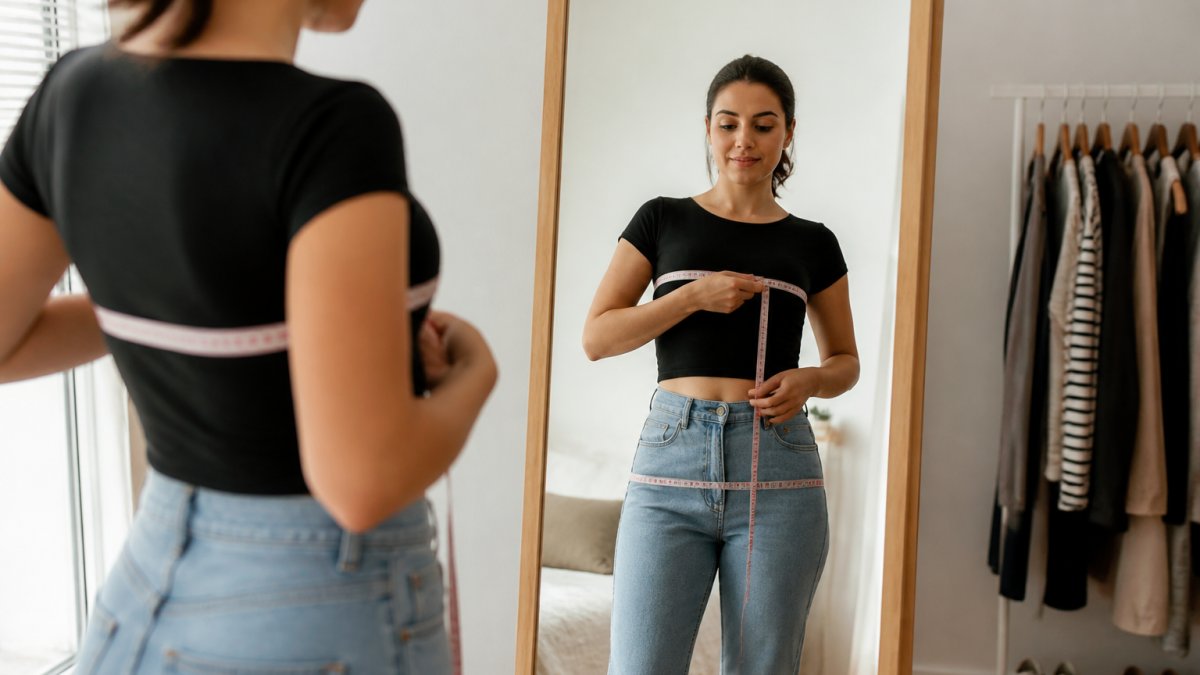
Measuring yourself accurately is the first step toward navigating inconsistent size charts. Most people measure themselves incorrectly, which compounds the sizing confusion. The key is to measure the same way the brand measures, and most brands measure finished garments, not bodies.
Essential Measurements and Where to Take Them
Start with chest, waist, and hip measurements. Chest: measure across the fullest part of your chest, keeping the tape parallel to the ground and snug but not tight. Waist: measure at your natural waist, typically the narrowest point between your ribs and hips.
For tops, also measure sleeve length from the center back of your neck to your wrist, and pit-to-pit (the measurement across the chest of a finished garment, which you can take from a shirt that fits you well).
Comparing Your Measurements to the Garment
Once you have your measurements, compare them to the finished-garment measurements on the size chart, not the "body measurements" section if one exists. A finished-garment chest of 104cm should fit a body with a chest measurement of 96-100cm. If the chart shows body measurements instead of finished-garment measurements, add 8-12cm to your body measurement to estimate the finished garment size.
| Measurement | Your Size | What to Compare |
|---|---|---|
| Chest | Record your chest measurement | Compare to finished-garment chest, not body size |
| Waist | Record your waist measurement | Compare to finished-garment waist with 6-10cm ease |
| Hip | Record your hip measurement | Compare to finished-garment hip measurement |
| Inseam | Measure inner thigh to ankle | Compare directly to garment inseam |
| Sleeve | Shoulder to wrist | Compare to finished-garment sleeve length |
Using a Clothing Size Calculator to Navigate Inconsistency
Smart sizing tools are changing how shoppers approach fit. Rather than relying on static size charts, a clothing size calculator can account for brand-specific variations, fabric behavior, and individual body proportions. These tools analyze your measurements against thousands of garments to recommend the size most likely to fit.
How Smart Sizing Tools Work
A clothing size calculator collects your measurements and body shape data, then compares them against a database of finished-garment measurements from hundreds of brands. The tool identifies patterns in how each brand sizes and uses that data to predict which size will fit you best.
The advantage is personalization at scale. Instead of guessing whether a brand's "Large" will fit your specific body shape, the calculator has already analyzed thousands of "Large" garments from that brand and can predict fit with reasonable accuracy.
Why AI-Driven Recommendations Account for Fabric and Fit
AI-driven sizing tools can factor in variables that static charts ignore: fabric composition, stretch percentage, garment construction, and intended silhouette. A tool trained on enough data learns that a brand's cotton shirts run small, but their stretch blends run true to size.
Fit Perfect AI uses full-body photo analysis to account for your unique proportions, then cross-references that against brand-specific sizing patterns and fabric characteristics. This approach delivers sizing recommendations tailored to every garment, fabric, and style.
The Hidden Factors Size Charts Ignore
Most size charts show only basic measurements. They omit the factors that actually determine whether a garment will fit. These hidden variables explain why two garments with identical size labels can fit completely differently.
Fit Models and Sample Garments
Brands design garments around fit models, real people with specific body proportions. If a brand's fit model is 178cm tall and pear-shaped, the garments are cut to flatter that silhouette. If you're 165cm tall and apple-shaped, the same size will drape differently on your body.
Sample garments, the prototypes used to test fit, also influence final sizing. If a brand's sample garment was cut slightly loose, the production version might be tighter. If the sample was stretched during fitting, production might feel smaller.
Garment Cut, Silhouette, and Intended Fit
A "slim fit" shirt from one brand is cut differently than a "slim fit" from another. The term is unregulated.
Silhouette, the overall shape of the garment, also affects how size translates to fit.
Finding your perfect fit online doesn't have to mean endless returns and sizing frustration.
Fit Perfect AI solves this by analyzing your unique body proportions through full-body photos and cross-referencing that data against brand-specific sizing patterns and fabric characteristics.
Frequently Asked Questions
Why do online size charts fail so often?
Online size charts fail because they don't account for the massive variation between brands. A size Large can span 14cm of waistline difference depending on the manufacturer. Additionally, size charts ignore fabric stretch, garment construction, fit model differences, and vanity sizing practices. Over 80% of shoppers report that size charts are inconsistent, and poor fit drives more than half of all online apparel returns. Charts treat sizing as one-size-fits-all when every brand interprets size labels differently.
What is vanity sizing explained in simple terms?
Vanity sizing is when brands label garments with smaller sizes than their actual measurements to make customers feel better about their size. A dress labeled size 8 might have the measurements of a traditional size 10. This practice is widespread across the industry and varies by brand. It makes shopping confusing because you can't rely on your usual size across different retailers. Vanity sizing directly contributes to online returns because shoppers base their choices on familiar size labels rather than actual measurements.
How do I measure myself for clothes accurately?
Start by wearing fitted clothing and use a soft measuring tape. Measure your chest at the fullest point, your waist at the narrowest part, and your hips at the widest point. For length, measure your inseam from your crotch to your ankle, and pit-to-pit for tops. Keep the tape snug but not tight. Write down all measurements. Then compare them to the finished-garment measurements listed on the product page, not your own body size. This tells you whether the garment will fit your actual body, regardless of what the size label says.
Can a clothing size calculator really predict fit better than size charts?
Yes, when designed well. A clothing size calculator that accounts for fabric composition, garment cut, and brand-specific sizing patterns can make better predictions than static charts. The most effective tools combine your actual body measurements with data about how specific fabrics stretch and how different brands cut their garments. Some use AI to learn from thousands of fit outcomes. However, no tool is perfect, individual body shape, proportions, and personal fit preferences still matter. Tools work best when they ask about your body type and preferred fit (snug vs. relaxed) alongside measurements.